

Google Rolls Out May 2026 Core Update This Weekend — What It Means for Your Website
What Is the Google May 2026 Core Update?
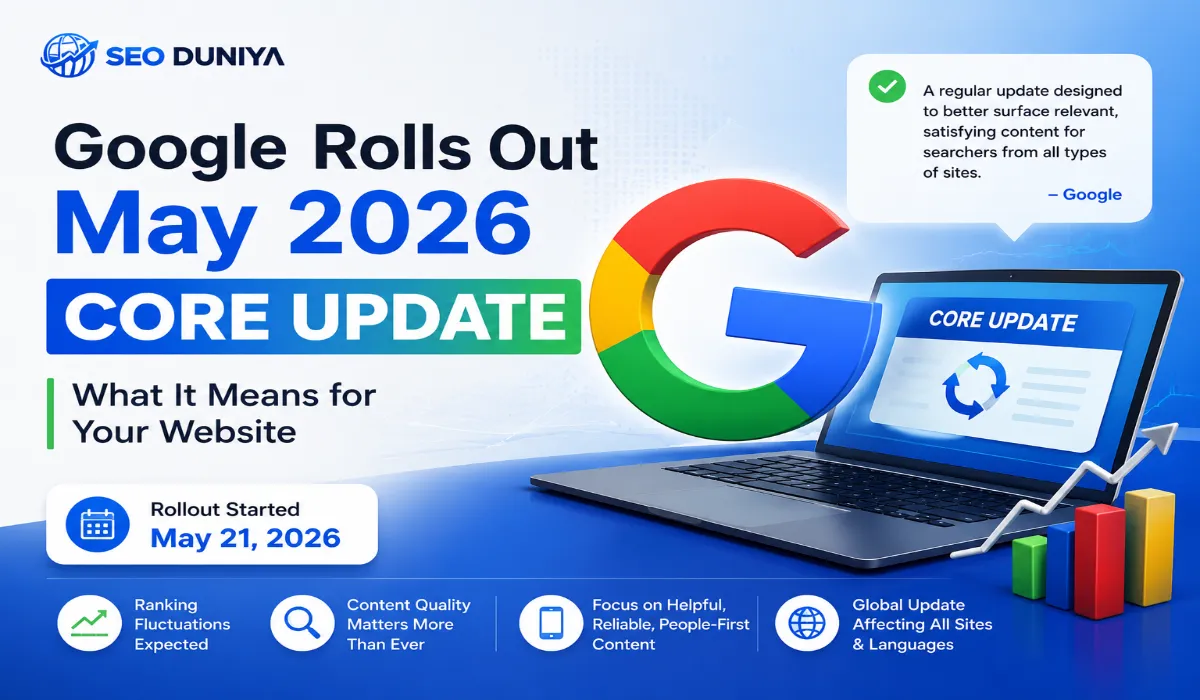
Google has officially rolled out its May 2026 Core Update — and if you own a website, you need to pay attention to this immediately.
The rollout started on May 21, 2026, and Google has confirmed it could take up to two weeks to fully complete. This is Google’s second broad core update of 2026, coming just six weeks after the March 2026 Core Update wrapped up on April 8.
Google made the announcement through its Search Status Dashboard and its official Search Central account on X (formerly Twitter). The company described it simply as:
“A regular update designed to better surface relevant, satisfying content for searchers from all types of sites.”
In plain words — Google is once again changing how it ranks websites so that better, more helpful content shows up at the top of search results.
If you have been noticing wild swings in your Google rankings or organic traffic since May 21, this update is most likely the reason.
Why Is This Core Update a Big Deal?
Every Google core update shakes up search rankings — but the May 2026 Google algorithm update stands out for a few reasons.
It Came Unusually Fast After the Last Update
Normally, Google waits three to four months between core updates. But this time, only six weeks passed between the March 2026 Core Update finishing and the May 2026 update starting. This is a sign that Google is speeding up how often it refreshes its ranking systems.
It Arrived Right After Google I/O 2026
Just two days before this update launched, Google held its Google I/O 2026 event, where it announced what it called “the biggest upgrade to Search in over 25 years.” This included major AI-powered search features built on Gemini technology. While Google has not directly linked these two events, the timing is hard to ignore.
It Is a Global Update
This is not limited to one country, language, or industry. The May 2026 core update affects all websites, in all languages, across all regions of the world. No one is exempt.
Recent Google Update Timeline You Should Know
To understand where this update fits, here is a quick look at the recent Google update history:
Google Updates in 2026 So Far
| Update Name | Rollout Dates | Duration |
| February 2026 Discover Core Update | February 5 – February 27, 2026 | 22 Days |
| March 2026 Spam Update | March 24 – March 25, 2026 | Under 20 Hours |
| March 2026 Core Update | March 27 – April 8, 2026 | 12 Days |
| May 2026 Core Update | Started May 21, 2026 | Up to 2 Weeks |
This frequent update schedule tells us one thing clearly — Google is no longer fine-tuning once in a while. It is constantly improving how it evaluates content quality. If your website is not keeping up, your rankings will feel it.
How Does This Google Core Update Affect Your Website?
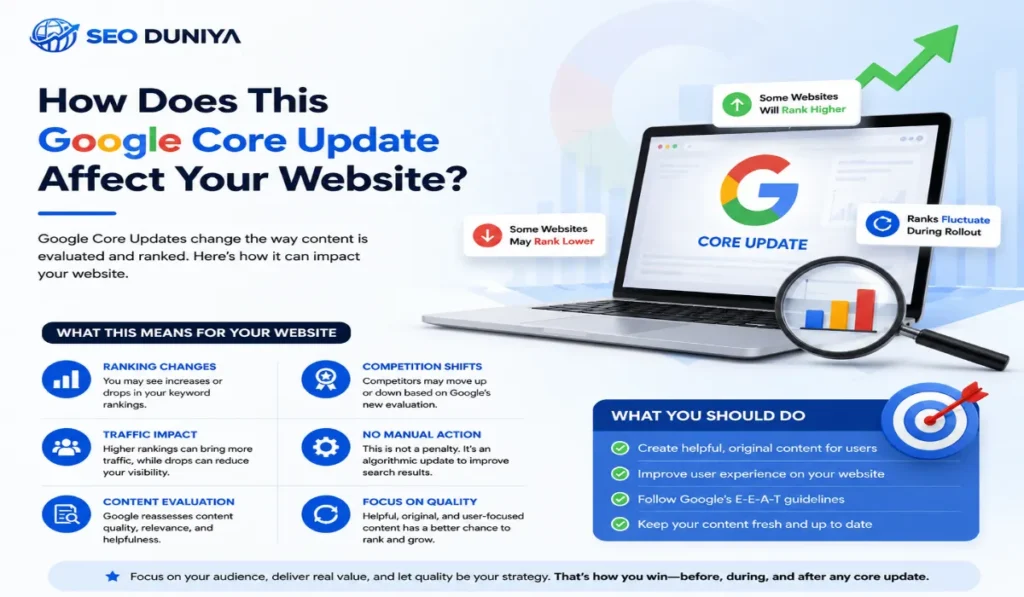
Core updates do not target specific websites or intentionally penalize anyone. Instead, Google updates the way it evaluates and ranks content across the web. As a result, some websites may see higher rankings, while others may experience a drop in visibility.
Websites That Could Gain Rankings
Your website has a good chance of benefiting from this Google search ranking update if it has:
- Original content that actually helps people solve a problem
- Real authors with genuine knowledge and credentials in the topic they write about
- Strong topical depth — covering a subject thoroughly, not just scratching the surface
- Good user experience includes fast loading speed, a mobile-friendly design, and easy website navigation for visitors.
- Quality backlinks from trusted and relevant websites
- High engagement — people stay on your pages and find what they are looking for
Websites That Could Lose Rankings
On the other hand, your website might see a drop in rankings if it relies on:
- AI-generated content that was published without any human editing or expert review
- Thin content that is short, vague, and does not give users real answers
- Keyword stuffing — writing content just to rank rather than to actually help people
- Outdated articles that have not been updated in a long time
- Poor user experience — slow pages, too many ads, hard to read on mobile
What Is E-E-A-T and Why Does It Matter in This Update?
If you follow SEO news, you have probably heard of E-E-A-T many times. It stands for Experience, Expertise, Authoritativeness, and Trustworthiness — and it is at the heart of how Google evaluates content quality.
Breaking Down E-E-A-T for Your Website
Experience means: Does the person writing the content have real, hands-on experience with the topic? Google wants to see content written by people who have actually done the thing they are talking about — not just someone who read about it online.
Expertise means: Is the author genuinely knowledgeable about the subject? For topics like health, finance, or legal advice, this matters even more. Google checks whether the author has the right qualifications and background.
Authoritativeness means: Is your website considered a trusted source in its niche? Do other reputable websites link to you and mention you? This builds your authority over time.
Trustworthiness means: Does your website look safe and reliable? Is it on HTTPS? Does it have a clear privacy policy, contact page, and transparent ownership? Are your sources accurate?
Websites that score well on all four of these factors tend to weather core updates better and often come out with improved rankings after the dust settles.
Step-by-Step: What to Do If Your Rankings Dropped
If you opened Google Search Console this week and saw your traffic drop, do not panic. Here is a clear action plan to follow after the May 2026 Google core update.
Step 1 — Wait for the Rollout to Finish
This is the most important advice. Do not make major changes to your website while the update is still rolling out. Rankings are still shifting every day until the rollout is complete. What looks like a big drop today could recover on its own by next week. Experts call this the “Google Dance.”
Wait until around June 4, 2026, before drawing any conclusions.
Step 2 — Check Google Search Console
Once the update is done, open Google Search Console and look at:
- Which pages lost the most impressions and clicks
- Which keywords dropped in ranking
- Whether there is a clear pattern — are the same types of pages getting hit?
Add a note (annotation) on May 21 in your analytics so you can compare before and after data clearly.
Step 3 — Do a Full Content Audit
Go through your affected pages and honestly ask yourself:
- Does this article actually answer what the reader is searching for?
- Is the information still accurate and up to date?
- Is there a named author with a proper bio and credentials?
- Is the content detailed enough, or is it too short and vague?
- Was this page written purely to rank, rather than to help a real person?
If the answer to any of these is a problem, that page needs work.
Step 4 — Improve and Update Your Content
Once you identify weak pages, the fix is simple in theory — make them genuinely better:
- Add more useful information and real examples
- Update any old statistics or outdated facts
- Add author bios with real credentials
- Include original insights that readers cannot find anywhere else
- Break up long blocks of text with subheadings, bullet points, and images
Step 5 — Fix Technical SEO Issues
Content quality is the main focus of core updates — but technical issues can drag you down too. Check:
- Page loading speed — use Google’s PageSpeed Insights tool
- Mobile usability — most users search on phones
- Broken links — both internal and external
- Core Web Vitals — especially Largest Contentful Paint (LCP) and Cumulative Layout Shift (CLS)
- Schema markup — structured data that helps Google understand your content
What Google Says About Recovering From Core Updates
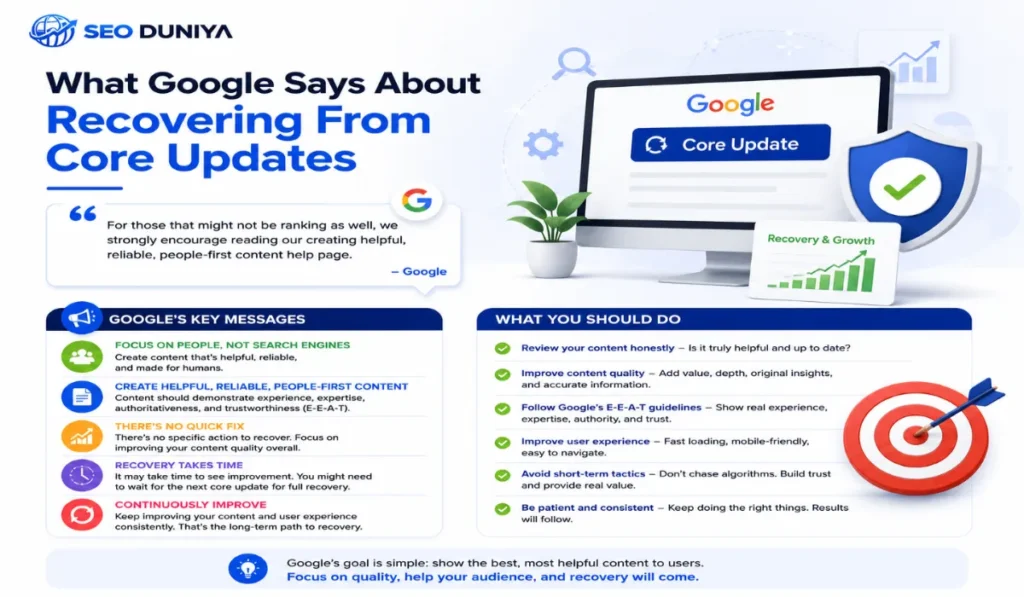
Google has been very clear that there is no magic fix for a core update hit. You cannot just change a few meta tags or tweak keywords and expect to bounce back.
Google’s official advice is:
“For those that might not be ranking as well, we strongly encourage reading our creating helpful, reliable, people-first content help page.”
The message is simple. If your site lost rankings, it means Google now thinks other websites are doing a better job of helping users on those topics. Your job is to close that gap — not by gaming the algorithm, but by genuinely making your content more useful, more accurate, and more trustworthy.
Recovery from core updates can take time. In many cases, you may not see improvement until the next core update refreshes Google’s evaluation of your site. That is why patience and a long-term approach matter more than quick fixes.
The Connection Between This Update and AI Search
One thing that makes this May 2026 core update different from older ones is the growing role of AI in Google Search. Google is now using advanced Gemini-based AI models to evaluate content quality at a much deeper level than before.
On top of that, AI Overviews (formerly called SGE) are now showing up for a huge number of searches. This means your content not only needs to rank in traditional results — it also needs to be good enough to get featured inside Google’s AI-generated answer boxes.
To improve your chances of appearing in AI Overviews:
- Write clear, direct answers to common questions early in your content
- Use FAQ sections where it makes sense
- Back up your claims with reliable sources and data
- Keep your content well-organized with proper headings so AI can easily read and extract it
Final Thoughts on the Google May 2026 Core Update
The Google May 2026 Core Update is not something to fear — but it is definitely something to take seriously. Google is getting smarter, faster, and better at telling the difference between content that truly helps people and content that is just trying to rank.
The websites that will keep growing in 2026 and beyond are the ones that treat their readers as real people with real questions — not just as traffic numbers. Write for humans first, follow Google’s quality guidelines, and the algorithm will take care of the rest.
If your site got hit, stay calm, be patient, do the hard work of improving your content — and results will follow.