The internet runs on traffic. Websites depend on visitors, publishers depend on readers, and businesses depend on people finding them through search. For years, Google has been the biggest driver of that traffic. But something is changing — and the latest data makes it impossible to ignore.
According to recent research, only 23% of Google searches now result in a click to the open web. That means out of every 100 people who search something on Google, only about 23 of them actually land on an external website. The rest either get their answer directly on Google’s search results page, or they click on something within Google’s own ecosystem.
This is not just a number. It is a fundamental shift in how Google operates — and it has serious consequences for every website, blog, news outlet, and online business that depends on search traffic to survive.
What Does “Open Web” Traffic Actually Mean?
When we say “open web,” we mean the millions of independent websites, blogs, news portals, e-commerce stores, and online platforms that exist outside of Google’s own products.
Every time someone clicks a search result and lands on one of these sites — that is open web traffic. It is the lifeblood of digital publishing. Ad revenue, product sales, email signups, brand awareness — all of it depends on people actually arriving at your website.
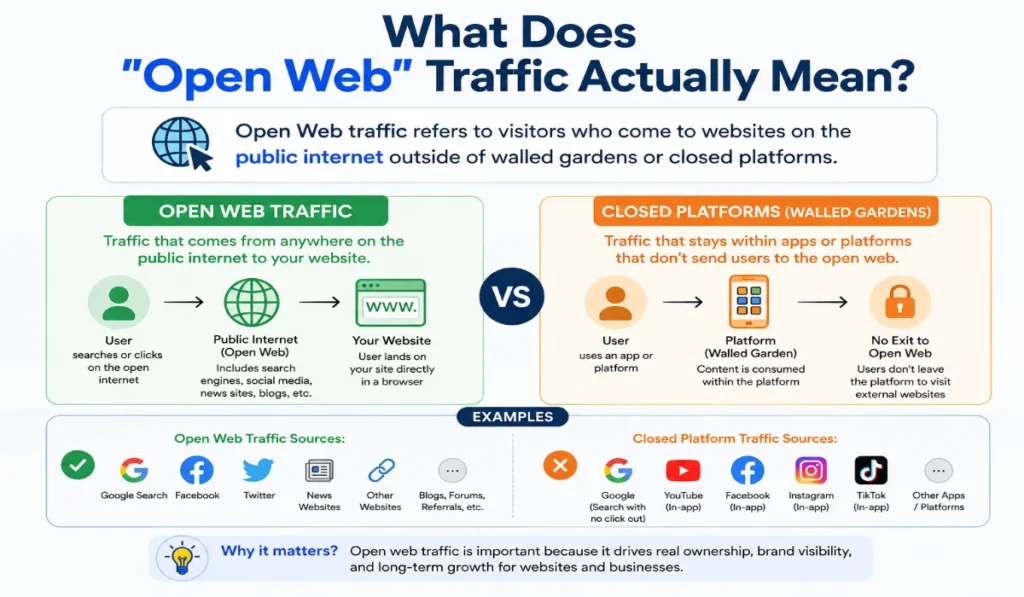
The drop to 23% means Google is now sending far less of this traffic than it used to. And this has been a steady, ongoing decline — not a sudden overnight change.
The Numbers: How Bad Is the Drop?
To truly understand the scale of this change, it helps to look at the data over time. A few years ago, more than half of all Google searches led to a click on an external website. Today, that number has fallen to nearly one in four.
| Year / Period | Estimated Open Web CTR | Zero-Click Share |
| 2019 (estimate) | ~50%+ | ~49% |
| 2021 | ~35–40% | ~57% |
| 2023 | ~28–32% | ~60%+ |
| 2025 (latest data) | ~23% | ~65%+ |
The trend is clear and consistent. Google search is increasingly becoming a destination in itself, rather than a gateway to the broader web.
Why Is Google Search Traffic Declining to the Open Web?
This drop did not happen by accident. There are several specific changes within Google’s search product that have directly caused this shift.
AI Overviews Are Answering Questions Directly
One of the biggest recent changes is the rollout of Google’s AI Overviews. These are AI-generated summaries that appear at the very top of search results, above all organic links.
When a user searches a question, Google’s AI reads multiple web pages, summarises the key information, and presents it directly on the results page. The user gets their answer without ever needing to click through to any website. This alone is responsible for a significant portion of the lost traffic to the open web.
Zero-Click Searches Have Become the Norm
Even before AI Overviews, Google was already moving in this direction through featured snippets, knowledge panels, and direct answer boxes. These features are designed to put the answer front and centre — right on the search results page itself.
For simple factual queries — like “what is the capital of France” or “how tall is Mount Everest” — users almost never need to click a website anymore. Google tells them instantly. This zero-click behaviour is now the dominant pattern for a large portion of searches.
Google Is Sending More Clicks to Its Own Products
When users do click something, they are increasingly clicking on Google-owned properties rather than external websites. Here is where those clicks are going:
- YouTube — for video content and tutorials
- Google Maps — for local business searches and directions
- Google Shopping — for product searches and price comparisons
- Google Flights and Hotels — for travel-related queries
- Google Images — for visual searches
These are all Google products. When a user clicks from Google Search to YouTube or Google Maps, that traffic never reaches the open web. It stays entirely within Google’s ecosystem.
People Also Ask Boxes Reduce the Need to Click
The “People Also Ask” (PAA) boxes that appear mid-results page are another major factor. These expandable question-answer sections allow users to explore multiple related queries without ever leaving the search results page. Each answer satisfies another potential reason to visit a website — and another lost click for publishers.
Who Is Getting Hurt the Most?
The impact of this traffic decline is not felt equally across all types of websites. Some categories are being hit much harder than others.
| Content Type | Impact Level | Why? |
| News and media publishers | Very High | AI Overviews summarise news stories directly |
| How-to and tutorial blogs | High | Featured snippets answer these completely |
| Definition and explainer sites | High | Knowledge panels replace these entirely |
| E-commerce stores | Medium | Google Shopping absorbs product search clicks |
| Local businesses | Medium | Google Maps and local packs take local searches |
| SaaS and software sites | Lower | Users still need to visit to sign up or use the product |
Publishers and informational websites are taking the heaviest losses. If your business model depends on traffic from question-based or how-to content, the impact of this shift is already very real.
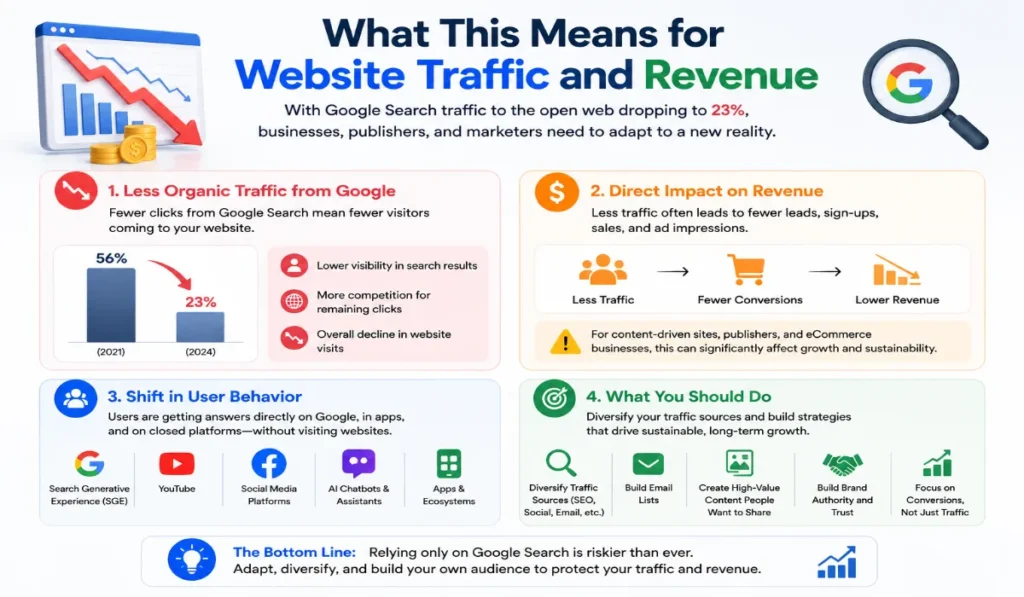
What This Means for Website Traffic and Revenue
The practical consequences of this shift are significant. Websites that built their audience on organic Google traffic are now finding that:
- Page view numbers are declining even when their rankings have not changed
- Click-through rates from Google have dropped significantly compared to previous years
- Ad revenue is falling because fewer visitors are arriving on site
- Top-ranking content is now being used to fuel AI Overviews without sending any traffic back
- Email list growth and lead generation have slowed because fewer people land on pages with sign-up forms
The painful irony is that a website can rank in position one on Google and still receive very little traffic — because the AI Overview sitting above it answers the question before anyone scrolls down to the organic results.
Is Google Doing This Intentionally?
This is a question many publishers and digital professionals are asking. The honest answer is: it is complicated.
Google’s stated mission is to organise the world’s information and make it universally accessible. Giving users faster, more direct answers genuinely serves that mission. From a user experience standpoint, AI Overviews and zero-click results are actual improvements — people get answers faster.
But Google also benefits commercially from keeping users inside its own ecosystem longer. More time on Google means more ad impressions, more YouTube watch time, more Google Shopping transactions. The incentives are clearly aligned for Google to reduce outbound traffic — regardless of whether that is the stated intention.
What is clear is that the effect on external publishers has been severe, and so far, Google has made no significant moves to reverse this trend.
How Are Publishers and Website Owners Responding?
Diversifying Traffic Sources
Many publishers are reducing their dependence on Google by building up other traffic channels — social media, email newsletters, direct app downloads, and online communities. The goal is to build an audience that does not require Google to reach them.
Focusing on Content Google Cannot Easily Summarise
In-depth investigative reporting, original research, proprietary data, exclusive interviews, and strong opinion content are much harder for AI systems to simply summarise. Publishers creating this type of content tend to retain more click-through traffic because users genuinely need to visit the page to get the full value.
Building a Recognisable Brand
Brands that users know and actively search for by name are better protected. If someone searches “TechCrunch AI news” rather than just “AI news,” they are likely to click through regardless of what AI Overviews say. Building a loyal, returning audience reduces exposure to zero-click risk significantly.
Exploring Legal and Regulatory Routes
In several countries, news publishers have pursued legal action or lobbied for legislation requiring Google to pay for the use of their content in AI-generated summaries. Australia has already passed legislation in this area, and similar conversations are ongoing in the EU and the UK.
What Does the Future Look Like?
If the current trend continues — and there is no strong reason to believe it will reverse — the open web’s share of Google search traffic could fall even further. AI capabilities are improving rapidly, and Google has shown no signs of slowing down the rollout of AI-powered search features.
Some analysts believe we are moving toward a future where the majority of Google searches produce zero outbound clicks. In that world, the open web does not disappear — but it becomes far less dependent on Google as a discovery mechanism than it has been for the past two decades.
The websites and publishers that will survive this shift are those that offer something AI summaries simply cannot replace: original reporting, real human perspective, exclusive tools, community, and content that requires the full page to be valuable.
Final Thoughts
The drop to 23% is more than a traffic statistic. It is a signal that the relationship between Google and the open web is changing in a fundamental way. For two decades, Google and websites existed in a mutually beneficial cycle — websites created content, Google ranked it, and Google sent traffic back to those websites in return.
That cycle is breaking down. Google is increasingly consuming web content to power its own AI features rather than directing users to the source. The traffic that used to flow outward to publishers is now staying inside Google.
Understanding this shift is the first step. How the publishing industry, regulators, and content creators respond to it will shape the future of the open web.
Frequently Asked Questions
Q1: Why is Google search traffic decreasing to websites?
Google is keeping users on its own platform through AI Overviews, featured snippets, and zero-click answers — so fewer people click through to external websites.
Q2: What is a zero-click search?
A zero-click search is when a user searches something on Google and gets their answer directly on the results page — without clicking any website link.
Q3: How do AI Overviews affect website traffic?
Google’s AI Overviews summarise content from multiple websites and display the answer at the top of search results, reducing the need for users to visit the original source.
Q4: Which websites are losing the most traffic from Google?
News publishers, how-to blogs, and informational websites are losing the most traffic as Google’s AI features directly answer the queries these sites used to rank for.
Q5: How can websites survive the Google traffic drop?
Websites can survive by diversifying traffic sources, building email lists, creating original research content, and building a strong brand that users search for directly.
What Is the Google May 2026 Core Update?
Google has officially rolled out its May 2026 Core Update — and if you own a website, you need to pay attention to this immediately.
The rollout started on May 21, 2026, and Google has confirmed it could take up to two weeks to fully complete. This is Google’s second broad core update of 2026, coming just six weeks after the March 2026 Core Update wrapped up on April 8.
Google made the announcement through its Search Status Dashboard and its official Search Central account on X (formerly Twitter). The company described it simply as:
“A regular update designed to better surface relevant, satisfying content for searchers from all types of sites.”
In plain words — Google is once again changing how it ranks websites so that better, more helpful content shows up at the top of search results.
If you have been noticing wild swings in your Google rankings or organic traffic since May 21, this update is most likely the reason.
Why Is This Core Update a Big Deal?
Every Google core update shakes up search rankings — but the May 2026 Google algorithm update stands out for a few reasons.
It Came Unusually Fast After the Last Update
Normally, Google waits three to four months between core updates. But this time, only six weeks passed between the March 2026 Core Update finishing and the May 2026 update starting. This is a sign that Google is speeding up how often it refreshes its ranking systems.
It Arrived Right After Google I/O 2026
Just two days before this update launched, Google held its Google I/O 2026 event, where it announced what it called “the biggest upgrade to Search in over 25 years.” This included major AI-powered search features built on Gemini technology. While Google has not directly linked these two events, the timing is hard to ignore.
It Is a Global Update
This is not limited to one country, language, or industry. The May 2026 core update affects all websites, in all languages, across all regions of the world. No one is exempt.
Recent Google Update Timeline You Should Know
To understand where this update fits, here is a quick look at the recent Google update history:
Google Updates in 2026 So Far
| Update Name | Rollout Dates | Duration |
| February 2026 Discover Core Update | February 5 – February 27, 2026 | 22 Days |
| March 2026 Spam Update | March 24 – March 25, 2026 | Under 20 Hours |
| March 2026 Core Update | March 27 – April 8, 2026 | 12 Days |
| May 2026 Core Update | Started May 21, 2026 | Up to 2 Weeks |
This frequent update schedule tells us one thing clearly — Google is no longer fine-tuning once in a while. It is constantly improving how it evaluates content quality. If your website is not keeping up, your rankings will feel it.
How Does This Google Core Update Affect Your Website?
Core updates do not target specific websites or intentionally penalize anyone. Instead, Google updates the way it evaluates and ranks content across the web. As a result, some websites may see higher rankings, while others may experience a drop in visibility.
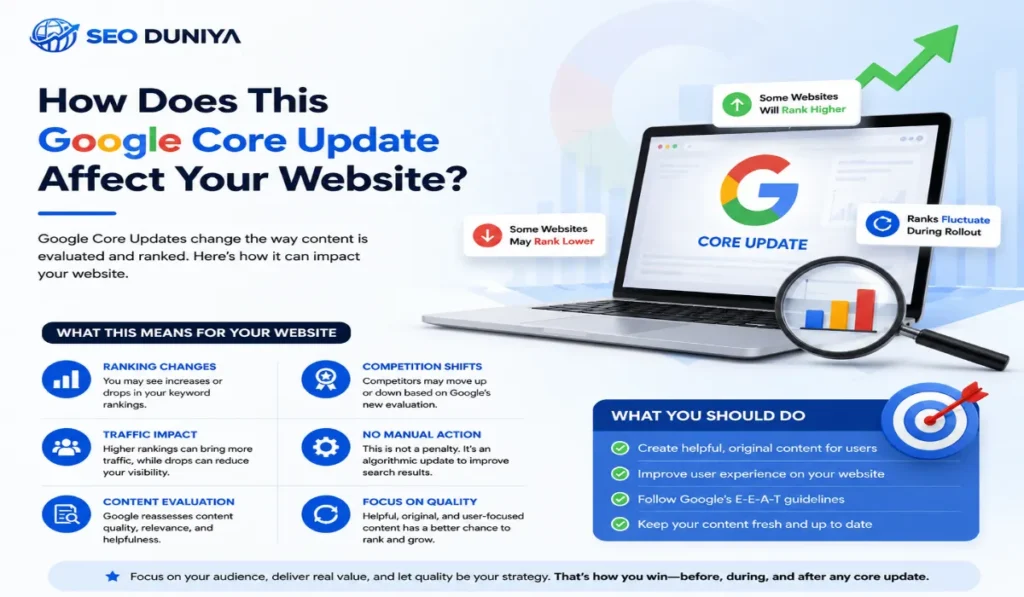
Websites That Could Gain Rankings
Your website has a good chance of benefiting from this Google search ranking update if it has:
- Original content that actually helps people solve a problem
- Real authors with genuine knowledge and credentials in the topic they write about
- Strong topical depth — covering a subject thoroughly, not just scratching the surface
- Good user experience includes fast loading speed, a mobile-friendly design, and easy website navigation for visitors.
- Quality backlinks from trusted and relevant websites
- High engagement — people stay on your pages and find what they are looking for
Websites That Could Lose Rankings
On the other hand, your website might see a drop in rankings if it relies on:
- AI-generated content that was published without any human editing or expert review
- Thin content that is short, vague, and does not give users real answers
- Keyword stuffing — writing content just to rank rather than to actually help people
- Outdated articles that have not been updated in a long time
- Poor user experience — slow pages, too many ads, hard to read on mobile
What Is E-E-A-T and Why Does It Matter in This Update?
If you follow SEO news, you have probably heard of E-E-A-T many times. It stands for Experience, Expertise, Authoritativeness, and Trustworthiness — and it is at the heart of how Google evaluates content quality.
Breaking Down E-E-A-T for Your Website
Experience means: Does the person writing the content have real, hands-on experience with the topic? Google wants to see content written by people who have actually done the thing they are talking about — not just someone who read about it online.
Expertise means: Is the author genuinely knowledgeable about the subject? For topics like health, finance, or legal advice, this matters even more. Google checks whether the author has the right qualifications and background.
Authoritativeness means: Is your website considered a trusted source in its niche? Do other reputable websites link to you and mention you? This builds your authority over time.
Trustworthiness means: Does your website look safe and reliable? Is it on HTTPS? Does it have a clear privacy policy, contact page, and transparent ownership? Are your sources accurate?
Websites that score well on all four of these factors tend to weather core updates better and often come out with improved rankings after the dust settles.
Step-by-Step: What to Do If Your Rankings Dropped
If you opened Google Search Console this week and saw your traffic drop, do not panic. Here is a clear action plan to follow after the May 2026 Google core update.
Step 1 — Wait for the Rollout to Finish
This is the most important advice. Do not make major changes to your website while the update is still rolling out. Rankings are still shifting every day until the rollout is complete. What looks like a big drop today could recover on its own by next week. Experts call this the “Google Dance.”
Wait until around June 4, 2026, before drawing any conclusions.
Step 2 — Check Google Search Console
Once the update is done, open Google Search Console and look at:
- Which pages lost the most impressions and clicks
- Which keywords dropped in ranking
- Whether there is a clear pattern — are the same types of pages getting hit?
Add a note (annotation) on May 21 in your analytics so you can compare before and after data clearly.
Step 3 — Do a Full Content Audit
Go through your affected pages and honestly ask yourself:
- Does this article actually answer what the reader is searching for?
- Is the information still accurate and up to date?
- Is there a named author with a proper bio and credentials?
- Is the content detailed enough, or is it too short and vague?
- Was this page written purely to rank, rather than to help a real person?
If the answer to any of these is a problem, that page needs work.
Step 4 — Improve and Update Your Content
Once you identify weak pages, the fix is simple in theory — make them genuinely better:
- Add more useful information and real examples
- Update any old statistics or outdated facts
- Add author bios with real credentials
- Include original insights that readers cannot find anywhere else
- Break up long blocks of text with subheadings, bullet points, and images
Step 5 — Fix Technical SEO Issues
Content quality is the main focus of core updates — but technical issues can drag you down too. Check:
- Page loading speed — use Google’s PageSpeed Insights tool
- Mobile usability — most users search on phones
- Broken links — both internal and external
- Core Web Vitals — especially Largest Contentful Paint (LCP) and Cumulative Layout Shift (CLS)
- Schema markup — structured data that helps Google understand your content
What Google Says About Recovering From Core Updates
Google has been very clear that there is no magic fix for a core update hit. You cannot just change a few meta tags or tweak keywords and expect to bounce back.
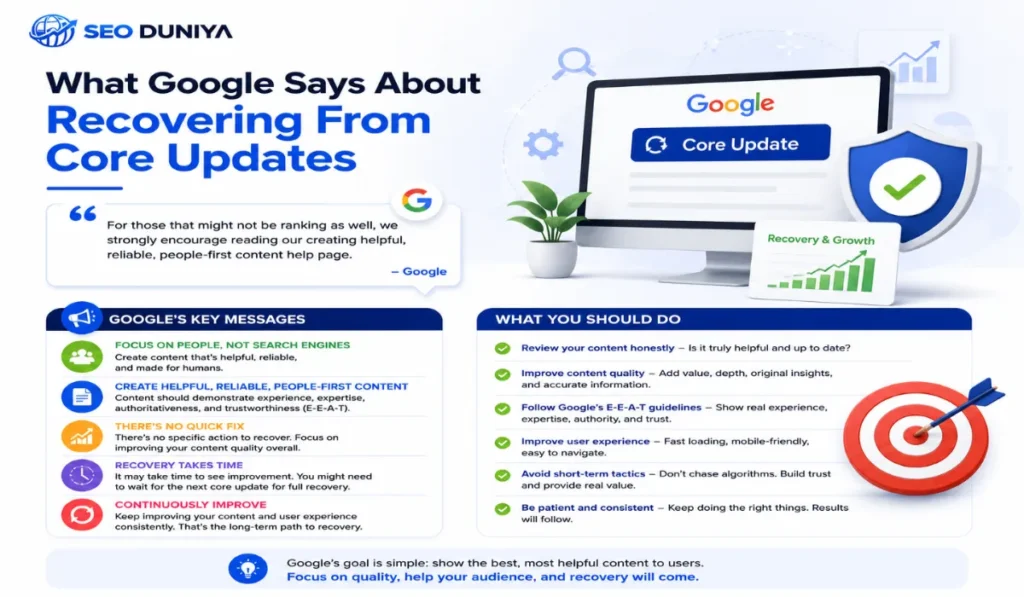
Google’s official advice is:
“For those that might not be ranking as well, we strongly encourage reading our creating helpful, reliable, people-first content help page.”
The message is simple. If your site lost rankings, it means Google now thinks other websites are doing a better job of helping users on those topics. Your job is to close that gap — not by gaming the algorithm, but by genuinely making your content more useful, more accurate, and more trustworthy.
Recovery from core updates can take time. In many cases, you may not see improvement until the next core update refreshes Google’s evaluation of your site. That is why patience and a long-term approach matter more than quick fixes.
The Connection Between This Update and AI Search
One thing that makes this May 2026 core update different from older ones is the growing role of AI in Google Search. Google is now using advanced Gemini-based AI models to evaluate content quality at a much deeper level than before.
On top of that, AI Overviews (formerly called SGE) are now showing up for a huge number of searches. This means your content not only needs to rank in traditional results — it also needs to be good enough to get featured inside Google’s AI-generated answer boxes.
To improve your chances of appearing in AI Overviews:
- Write clear, direct answers to common questions early in your content
- Use FAQ sections where it makes sense
- Back up your claims with reliable sources and data
- Keep your content well-organized with proper headings so AI can easily read and extract it
Final Thoughts on the Google May 2026 Core Update
The Google May 2026 Core Update is not something to fear — but it is definitely something to take seriously. Google is getting smarter, faster, and better at telling the difference between content that truly helps people and content that is just trying to rank.
The websites that will keep growing in 2026 and beyond are the ones that treat their readers as real people with real questions — not just as traffic numbers. Write for humans first, follow Google’s quality guidelines, and the algorithm will take care of the rest.
If your site got hit, stay calm, be patient, do the hard work of improving your content — and results will follow.