
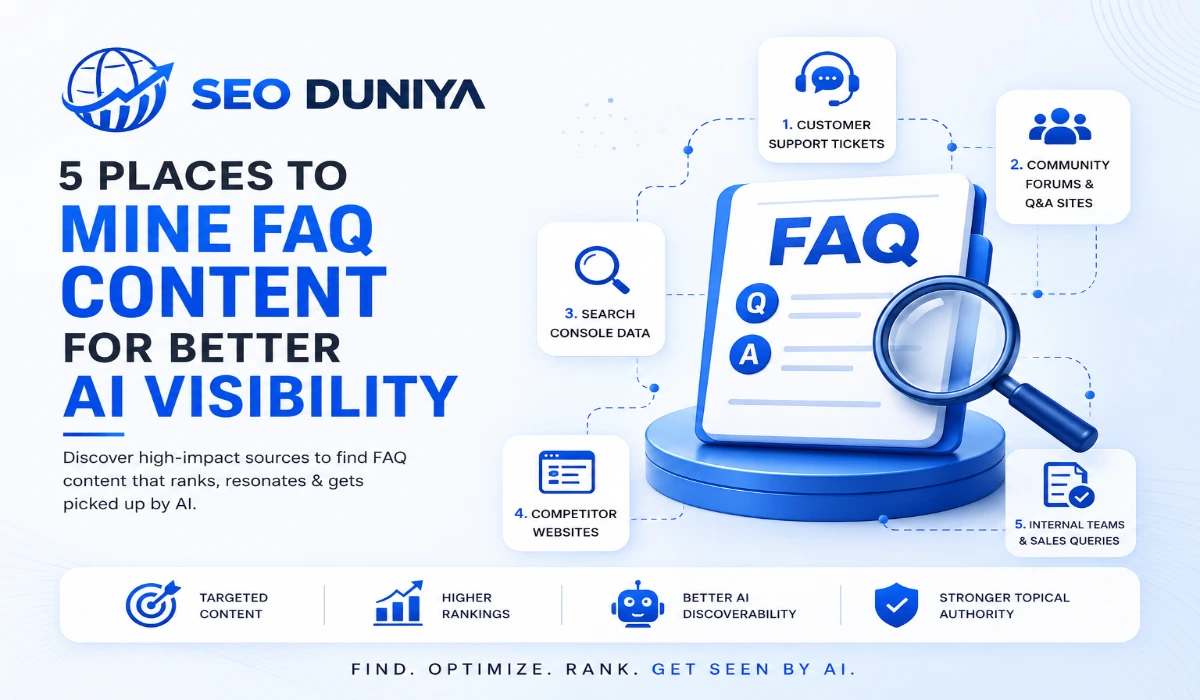

5 Places to Mine FAQ Content for Better AI Visibility
Why FAQ Content Now Rules Search
Search has changed. People no longer just type short keywords. They ask full questions. They type things like:
- “What is the best way to improve AI visibility?”
- “How does FAQ content help with SEO?”
- “Where do I find questions my audience is asking?”
AI tools like ChatGPT, Perplexity, Google AI Overviews, and Bing Copilot read these questions and pull answers from pages that are clear, structured, and helpful.
This shift is why FAQ content is now one of the most powerful SEO strategies in 2025.
When you write FAQ-style content, you match the exact way people search. You also match the way AI engines read and cite content. This is the heart of two growing strategies:
- AEO (Answer Engine Optimization) — Getting your content cited by AI answer tools
- GEO (Generative Engine Optimization) — Appearing inside AI-generated search results
But before you write a single FAQ, you need to know where to find the right questions. That is exactly what this guide covers.
What Is FAQ Mining?
FAQ mining means finding the real questions your audience types online — and then writing content that answers those questions directly.
When you do it right, your content:
- Shows up in Google’s People Also Ask boxes
- Gets cited in AI-generated answers
- Ranks for long-tail conversational keywords
- Builds trust and topical authority in your niche
| Content Strategy | What It Targets | Main Benefit |
| AEO | ChatGPT, Perplexity, AI tools | AI citations and mentions |
| GEO | Google AI Overviews | Generative search visibility |
| Traditional SEO | Google organic results | Clicks and impressions |
| FAQ Content | All three above | Traffic from every channel |
The best part? You do not need expensive tools to find great FAQ topics. You just need to know where to look.
1. Google “People Also Ask” — The Free Goldmine
Google’s People Also Ask (PAA) section is one of the most powerful FAQ sources you can use — and it is completely free.
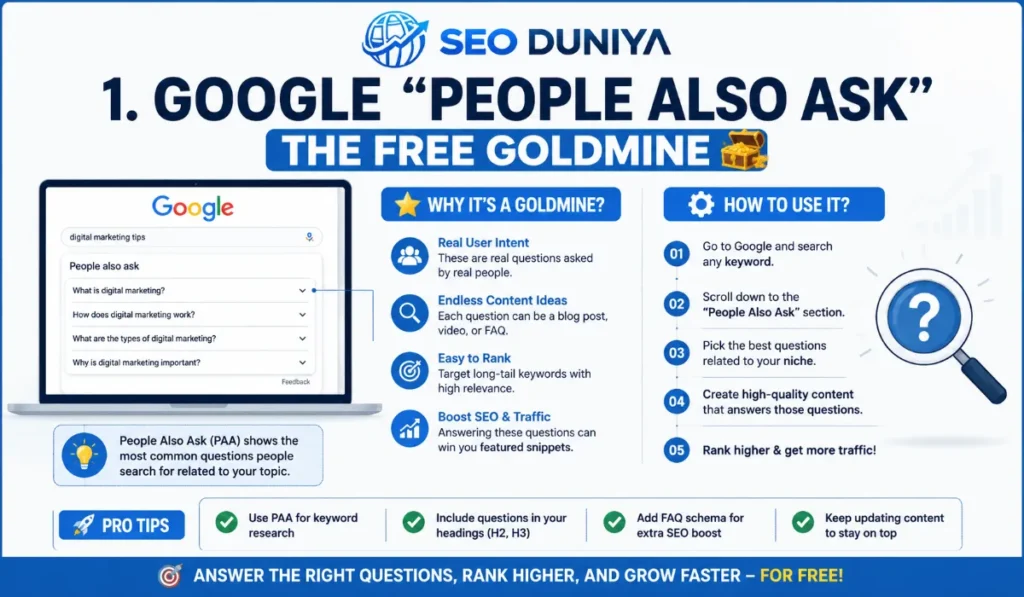
Every time someone searches on Google, PAA shows a list of related questions that real users are asking. These are not made-up questions. They come from actual search data.
How to Use It
- Open Google and search your main keyword
- Scroll down to find the “People Also Ask” box
- Click on each question — more questions will expand below
- Collect 15–20 questions per topic
- Group similar questions into content clusters
Why It Matters for AEO and GEO
Google AI Overviews often pull answers directly from pages that already rank in PAA. If your content answers a PAA question clearly and directly, AI tools are far more likely to cite your page.
Quick Tip: Always answer the question in your first 2–3 sentences. AI engines prioritize pages that give direct answers fast.
| PAA Advantage | AI Visibility Impact |
| Shows real search intent | Aligns with AI query patterns |
| Free to use anytime | No tool cost |
| Updates regularly | Fresh question data always |
2. Reddit and Quora — Where Raw Questions Live
Reddit and Quora are two platforms where people ask questions they feel too embarrassed to Google. That means you find honest, unfiltered, high-intent questions — perfect for FAQ content.
How to Mine Reddit
- Search your niche topic on reddit.com
- Filter posts by Top and Hot
- Look for threads with the most comments
- Read the comment section — follow-up questions there are often gold
- Note the exact words people use
How to Mine Quora
- Search your keyword on quora.com
- Filter by Most Answered
- Read multiple answers — the questions people ask in comments are even better than the main post
Why This Works for GEO
Generative engines like Perplexity often surface content that mirrors community discussions. When your content uses the same natural language that Reddit and Quora users write in, it matches the same queries AI tools receive every day.
3. Amazon and Product Reviews — A Hidden FAQ Database
This source surprises most content creators — but it works incredibly well, especially for product-based niches.
Amazon’s product pages contain thousands of real customer questions. These are questions buyers had before, during, or after their purchase. They show you exactly what people want to know.
How to Extract FAQ Topics
- Go to any relevant product page on Amazon
- Scroll to “Customer Questions & Answers”
- Read 1-star and 3-star reviews — these hold the most unanswered concerns
- Look for phrases like “I wish I knew,” “no one explains,” “confused about”
Each phrase signals a content gap you can fill.
AEO Opportunity Here
When someone asks ChatGPT “What should I know before buying X?”, the AI pulls from pages that answer pre-purchase questions clearly. Your FAQ content can earn that citation.
| Review Type | Signal to Look For | FAQ Angle to Write |
| 1-star reviews | Unmet expectations | “What does X actually include?” |
| 3-star reviews | Confusion or missing info | “How does X work step by step?” |
| Q&A section | Direct buyer questions | Use exact phrasing as FAQ title |
4. Your Own Customer Emails and Support Chats
This is the most overlooked source on this list — and the most valuable.
Your existing customers ask you questions every single day. These questions are 100% real, 100% relevant, and come directly from your target audience. There is no better FAQ research than this.
How to Turn Support Data Into FAQ Content
- Export your last 3 months of support emails or chat logs
- Highlight questions that appear 3 or more times
- Group them into topics: pricing, features, troubleshooting, how-to, comparisons
- Write one FAQ section or blog post per topic cluster
Why This Is Perfect for AEO
Answer engines work best with content that matches real user intent. Nothing is more intentional than a question your actual customer typed. These questions often have zero competition in search — meaning your content ranks faster.
Pro Tip: Add a simple tag system to your support inbox. After 30 days of tagging questions by topic, you will have a full FAQ content calendar ready to go.
5. Ask AI Tools Directly — The Fastest Shortcut
This is the smartest FAQ mining hack of 2025. You can ask AI tools directly what questions people have about your topic — and then create content to answer those questions.
Prompts That Work
Open ChatGPT, Claude, or Perplexity and try:
- “What are the 20 most common questions people ask about [your topic]?”
- “List FAQs someone would search before buying [your product].”
- “What does someone need to know about [topic] that most websites miss?”
You get a full list of high-intent questions in under a minute.
GEO Advantage of This Method
AI tools answer the same questions their users ask them. By asking AI what people ask, you reverse-engineer the content gaps AI tools have — and fill them with your pages.
| AI Tool | Best Use for FAQ Mining |
| ChatGPT | Broad topic FAQs and intent research |
| Perplexity | Research-backed questions with sources |
| Claude | Nuanced framing and content structuring |
| Google Gemini | PAA-aligned Google-focused question lists |
How to Structure FAQ Content for Maximum AI Visibility
Finding questions is only half the work. You need to structure your answers so AI can read and cite them easily.
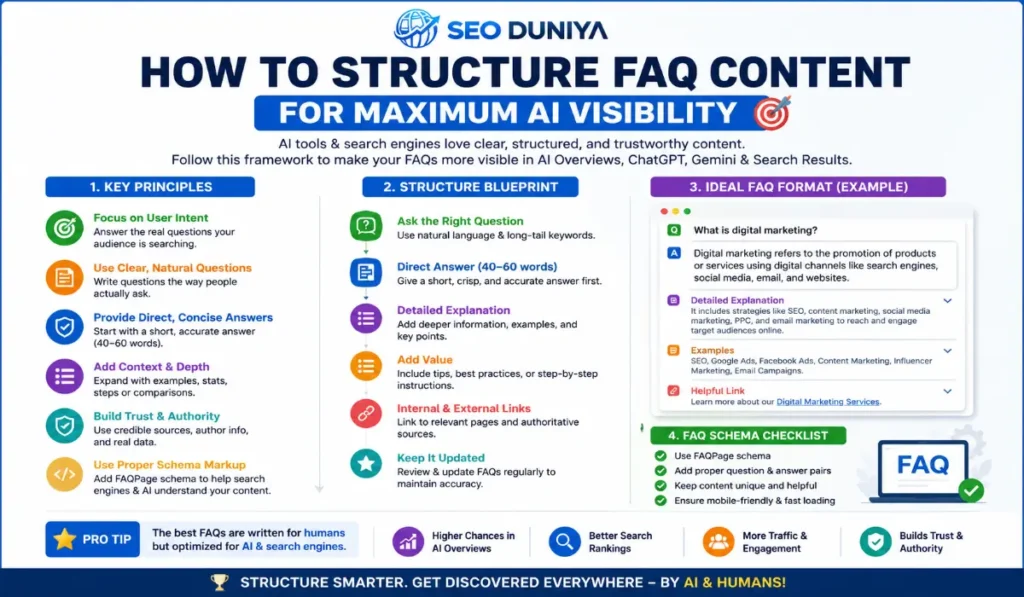
Use this simple format for every FAQ:
- Put the exact question as your heading (H3)
- Answer it in 2–3 clear sentences right away
- Add a supporting detail, example, or stat
- End with a related question or next step
This structure works for Google featured snippets and AI-generated answers. It tells every search engine — human or machine — that your content is trustworthy and complete.
Quick Summary Checklist
| Source | Time Needed | Best For |
| Google PAA | 15 minutes | High-volume, fast-win queries |
| Reddit & Quora | 30 minutes | Conversational, long-tail FAQs |
| Amazon Reviews | 20 minutes | Product and buyer-intent content |
| Customer Support Data | 1 hour | Niche, high-intent FAQs |
| AI Tools | 10 minutes | Quick ideation and gap research |
Final Thoughts
AI search does not replace content — it rewards better content. When you mine FAQ topics from the right sources and write clear, direct answers, your pages start appearing inside AI-generated results, featured snippets, and People Also Ask boxes.
Pick one source from this list today. Find 10 real questions your audience is asking. Write honest, clear answers.
That is how you build AI visibility — one helpful answer at a time.
Bookmark this guide and revisit it every quarter as AI search behavior keeps evolving.
Frequently Asked Questions
Q1. What is FAQ content in SEO?
FAQ content is a format where you write questions your audience asks and answer them clearly on your page. It helps search engines and AI tools understand what your page is about and when to show it in results.
Q2. How does FAQ content improve AI visibility?
AI tools like ChatGPT and Perplexity look for pages that directly answer questions. When your content is structured in a question-and-answer format, AI engines find it easier to read and cite your page in their responses.
Q3. What is AEO and how is it different from SEO?
SEO helps you rank on Google’s search results page. AEO (Answer Engine Optimization) helps your content appear inside AI-generated answers on tools like ChatGPT, Perplexity, and Google AI Overviews. FAQ content supports both at the same time.
Q4. What is GEO in content marketing?
GEO stands for Generative Engine Optimization. It means writing content in a way that AI-powered search tools like Google SGE can pull and show to users directly inside their generated responses.
Q5. How many FAQs should I add to a blog post?
Aim for 5 to 10 FAQs per blog post. Each FAQ should answer one specific question in 2–4 sentences. Keep answers clear and direct so both readers and AI tools can understand them fast.
Q6. Do FAQs help with Google featured snippets?
Yes. Google often pulls FAQ answers directly into featured snippets and People Also Ask boxes. When you use the exact question as a heading and answer it immediately below, you increase your chances of winning a featured snippet.
Q7. Which is the best free tool to find FAQ topics?
Google’s People Also Ask section is the best free tool for FAQ research. It shows real questions from real users. You can also use Reddit, Quora, and AI tools like ChatGPT to find additional question ideas at no cost.