Search has changed dramatically over the past few years. Users no longer rely only on Google Search to find answers. Today, millions of people ask questions directly to AI platforms like ChatGPT, Google AI Mode, Gemini, Microsoft Copilot, Claude, and Perplexity AI.
This shift has introduced a new digital marketing metric known as AI Visibility Measurement. Instead of focusing only on keyword rankings, businesses now need to measure how often AI assistants mention, recommend, or reference their websites, products, and services.
Traditional SEO is still important, but AI-powered search engines evaluate authority, trust, structured data, topical expertise, and user satisfaction differently. If your brand isn’t visible in AI-generated responses, you’re missing a growing source of traffic and brand awareness.
In this guide, you’ll learn what AI Visibility Measurement is, why it matters, which metrics to track, and how to improve your visibility across AI search platforms using modern SEO and GEO (Generative Engine Optimization) strategies.
What Is AI Visibility Measurement?
AI Visibility Measurement is the process of tracking and analyzing how frequently your website, brand, or content appears in responses generated by artificial intelligence platforms.
Instead of measuring only search rankings, AI visibility focuses on questions such as:
- Does ChatGPT mention your website?
- Is your brand recommended by Gemini?
- Does Perplexity cite your content?
- Does Google AI Overview reference your pages?
- Are your products suggested when users ask AI for recommendations?
The better your AI visibility, the greater your chances of attracting highly qualified users from AI-powered search experiences.
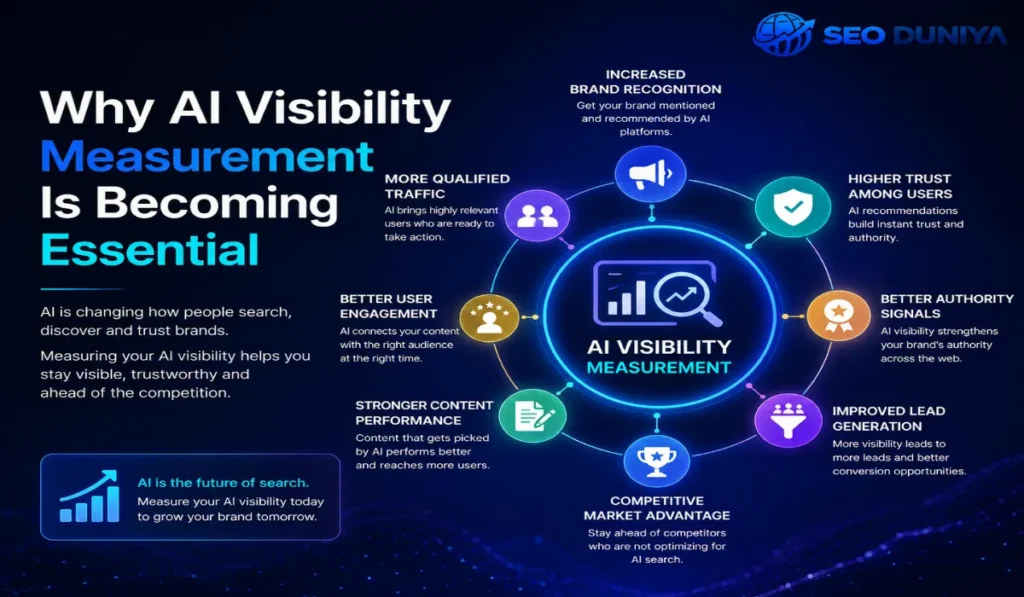
Why AI Visibility Measurement Is Becoming Essential
AI search is changing user behavior.
Instead of opening ten search results, users now receive one complete answer generated by AI. That means websites receiving AI citations gain significantly more trust and attention.
Some major reasons businesses should monitor AI visibility include:
- Increased brand recognition
- More qualified traffic
- Higher trust among users
- Better authority signals
- Improved lead generation
- Stronger content performance
- Competitive market advantage
Companies that start optimizing for AI today will likely dominate tomorrow’s search landscape.
Traditional SEO vs AI Visibility Measurement
Although both aim to increase online presence, they measure different aspects of search performance.
| Traditional SEO | AI Visibility Measurement |
| Keyword rankings | AI citations |
| Organic traffic | AI-generated mentions |
| SERP positions | AI recommendation frequency |
| Click-through rate | AI answer inclusion |
| Backlinks | Authority and trust signals |
| Indexed pages | Knowledge graph presence |
| Featured snippets | AI-generated summaries |
The future belongs to businesses that combine both SEO and AI optimization.
How AI Systems Decide Which Websites to Mention
AI models don’t randomly select websites.
They evaluate multiple trust and authority signals before recommending a source.
Some important ranking factors include:
High-Quality Content
AI prefers detailed, original, and factually accurate content that answers user questions completely.
Topical Authority
Publishing multiple articles around a specific subject increases your expertise.
For example, if your website covers AI marketing, publish content about:
- AI SEO
- GEO
- AI Search Optimization
- AI Crawlers
- AI Citations
- AI Content Strategy
- AI Visibility Measurement
Together, these build topical authority.
Structured Data
Schema markup helps AI understand your content.
Useful schema types include:
- Article Schema
- FAQ Schema
- Organization Schema
- Breadcrumb Schema
- Product Schema
- Review Schema
Structured data improves machine readability and increases the likelihood of AI references.
Brand Authority
AI platforms often recommend well-established brands with consistent online presence.
Authority grows through:
- High-quality backlinks
- Expert content
- Positive reviews
- Brand mentions
- Strong social signals
Content Freshness
AI systems favor recently updated content.
Refreshing older articles with new statistics, examples, and insights improves AI visibility.
Key Metrics for AI Visibility Measurement
Businesses should monitor several metrics instead of relying on rankings alone.
AI Brand Mentions
Track how often AI assistants mention your business.
AI Citations
Monitor whether AI platforms cite your website as a trusted source.
AI Referral Traffic
Use analytics tools to identify visitors arriving from AI platforms.
AI Conversion Rate
Measure how many AI visitors become customers.
AI Share of Voice
Compare your AI visibility against competitors.
Knowledge Graph Presence
Ensure your brand information appears consistently across trusted platforms.
Entity Recognition
Search engines increasingly rely on entities instead of keywords.
Build strong entity relationships through consistent branding.
Best Tools for AI Visibility Measurement
Several modern tools help monitor AI search performance.
1. Google Search Console
Track organic impressions, clicks, and AI-related search trends.
2. Google Analytics 4
Measure AI referral traffic and conversions.
3. Ahrefs
Analyze backlinks, authority, and keyword performance.
4. Semrush
Monitor visibility, competitor performance, and brand growth.
5. Screaming Frog
Audit technical SEO and structured data.
6. Bing Webmaster Tools
Useful for Microsoft Copilot optimization.
7. AI Monitoring Platforms
New AI analytics platforms track:
- ChatGPT mentions
- Gemini visibility
- Perplexity citations
- Claude references
- AI recommendation frequency
These tools are becoming increasingly valuable for GEO professionals.
How to Improve AI Visibility Measurement
Improving AI visibility requires more than keyword optimization.
Create Comprehensive Content
Publish detailed articles that completely answer user intent.
Long-form guides generally perform better in AI-generated responses.
Answer Real Questions
Structure content around questions users genuinely ask.
Examples:
- What is AI Visibility Measurement?
- How do AI search engines rank websites?
- Why is GEO important?
Question-based content is easier for AI to understand.
Build Topical Clusters
Instead of isolated blogs, create interconnected content around one topic.
Example cluster:
AI Search
↓
AI SEO
↓
GEO
↓
AI Crawlers
↓
AI Visibility Measurement
↓
AI Ranking Factors
↓
AI Analytics
Internal linking strengthens authority.
Improve EEAT Signals
Google and AI systems value:
- Experience
- Expertise
- Authoritativeness
- Trustworthiness
Display author information, update content regularly, cite credible sources, and maintain factual accuracy.
Optimize for Entities
Mention recognized entities naturally.
Examples include:
- ChatGPT
- Google AI Mode
- Gemini
- Microsoft Copilot
- Claude
- Perplexity AI
Entity optimization helps AI better understand context.
Add Schema Markup
Schema improves machine readability.
Recommended schema:
- FAQ
- Article
- Organization
- Person
- Breadcrumb
- Review
Build High-Quality Backlinks
Authority remains one of the strongest trust signals.
Focus on backlinks from:
- Industry blogs
- News websites
- Educational institutions
- Research publications
Keep Content Updated
AI platforms prioritize current information.
Review important pages every few months.
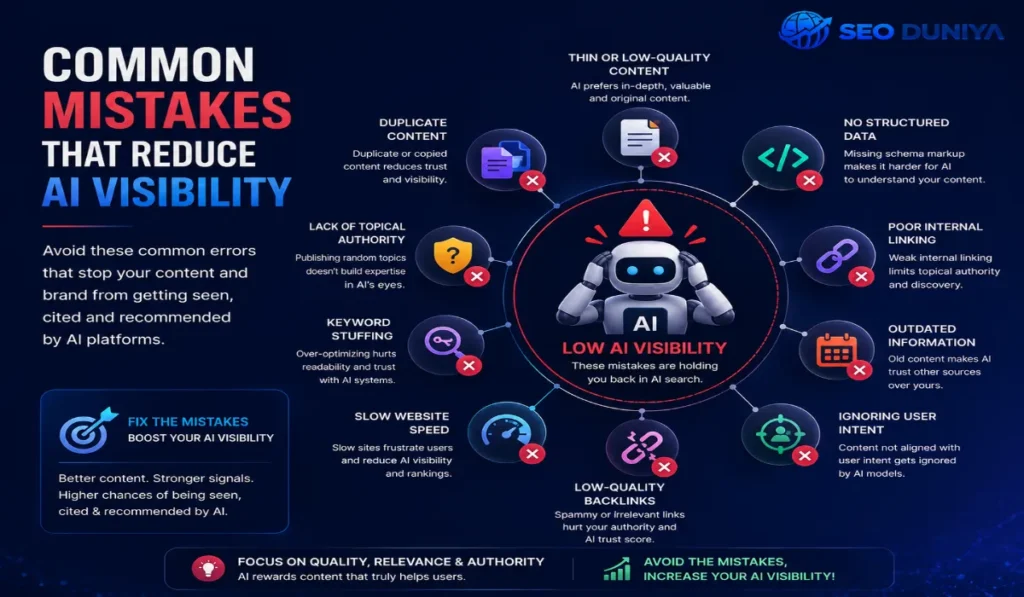
Common Mistakes That Reduce AI Visibility
Many websites unknowingly limit their AI visibility by making avoidable mistakes.
Common issues include:
- Thin content
- Duplicate articles
- Poor internal linking
- Missing schema markup
- Slow website speed
- Low-quality backlinks
- Outdated information
- Weak topical authority
- Keyword stuffing
- Ignoring user intent
Avoiding these problems significantly improves your chances of appearing in AI-generated responses.
The Future of AI Visibility Measurement
AI-powered search is expected to become the primary way users discover information online.
Instead of simply ranking webpages, AI engines will rank trusted entities, authoritative brands, and reliable knowledge sources.
Future AI visibility metrics may include:
- AI citation score
- AI authority index
- Brand recommendation frequency
- Multi-model visibility score
- Entity confidence rating
- AI engagement signals
Businesses investing in GEO today will be better positioned as AI search continues to evolve.
Final Thoughts
AI Visibility Measurement is rapidly becoming one of the most important performance metrics in digital marketing. While traditional SEO focuses on search rankings, AI visibility measures whether your brand is recognized, cited, and recommended by AI-powered search engines and assistants.
To improve your AI visibility, focus on publishing authoritative content, building topical authority, implementing structured data, earning quality backlinks, strengthening EEAT signals, and optimizing for entities rather than relying solely on keywords. By combining proven SEO practices with Generative Engine Optimization (GEO), businesses can increase their chances of being featured in AI-generated answers, attract high-intent users, and stay competitive in the future of search.
As AI search continues to evolve, measuring and improving your AI visibility will become just as important as tracking traditional keyword rankings. Organizations that adapt early will gain stronger brand recognition, greater trust, and sustainable organic growth in the AI-first era.
Think about the last time you typed a full keyword into Google.
Chances are, you didn’t. You asked a question. You typed a sentence. Maybe you even talked to your phone.
That shift is not an accident. Google has been moving away from keyword-matching for years. But now, with the rise of Google AI Brief — the newer, sharper evolution of AI Overviews — that shift is becoming a full transformation.
If you are a content creator, blogger, marketer, or business owner, this matters to you. A lot.
This blog breaks down what Google AI Brief is, why it might replace keywords as we know them, and what you need to do right now to stay visible in the new search world.
What Is Google AI Brief?
Google AI Brief is Google’s AI-generated summary that appears at the top of search results. It reads your query, pulls information from multiple sources, and gives you a direct, clear answer — all without you having to click a single link.
It is the next step after Google’s SGE (Search Generative Experience) and AI Overviews. While AI Overviews launched in 2023 to mixed reviews, Google AI Brief is a more refined version — faster, more accurate, and more conversational.
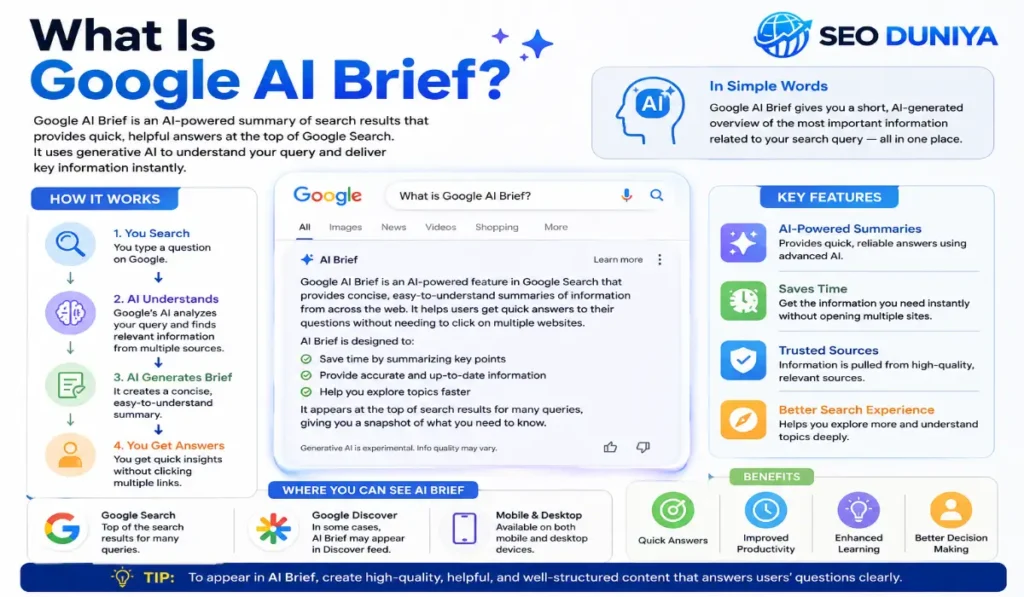
Think of it like having a very smart assistant that reads the internet for you and gives you the best answer in a few sentences.
How Is It Different from Traditional Search?
Traditional search worked like this:
- You type a keyword → Google shows 10 blue links → You click one → You find your answer.
Google AI Brief works like this:
- You ask a question → Google’s AI reads thousands of pages → It gives you a direct answer right there.
The keyword was the “key” that unlocked results. But now, the key is the question itself — and AI is the one answering it.
Why Keywords Alone Are No Longer Enough
For the last 20+ years, SEO was a keyword game. Stuff the right words in the right places, and Google would rank you.
That era is not over — but it is fading.
Here is why keywords are losing their grip:
1. Users Search in Natural Language
People no longer type “best coffee Delhi 2024.” They say, “Where can I find a good cup of coffee near me right now?”
This is called conversational search, and Google AI Brief is built for exactly this kind of query.
2. AI Understands Intent, Not Just Words
Old Google matched your words to pages. New Google understands what you mean. It figures out your intent — are you looking to buy, learn, compare, or find a location? — and answers accordingly.
Keywords are just signals. Intent is the real message.
3. Zero-Click Searches Are Growing
When AI Brief gives users the answer right on the search page, they do not need to click. Studies show that over 60% of searches now end without a click. Keywords bring traffic only if someone clicks. AI Brief changes that equation entirely.
What Is GEO and Why Does It Matter Now?
GEO stands for Generative Engine Optimization.
It is the practice of optimizing your content not just for traditional search engines, but for AI systems that generate answers — like Google AI Brief, ChatGPT search, Perplexity, and others.
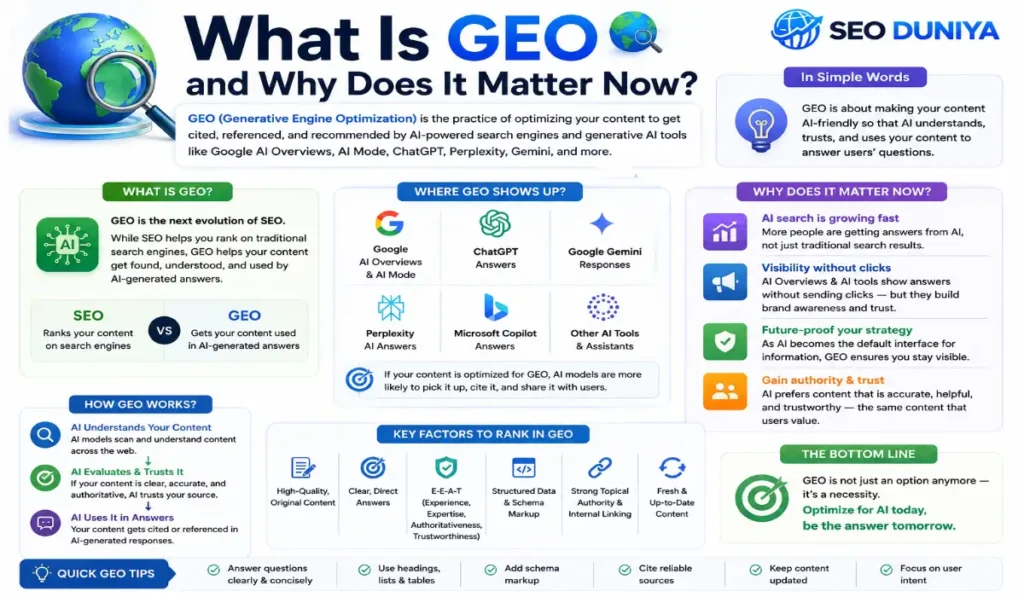
With GEO, your goal is not just to rank on page one. Your goal is to be the source the AI quotes or references when it builds its answer.
How to Optimize for GEO
- Write clear, factual content. AI systems love content that is easy to extract and verify.
- Use structured data. Schema markup helps AI understand what your page is about.
- Answer questions directly. Start your answers with the answer — not a long intro.
- Build authority. AI systems favor sources that are cited, linked to, and trusted.
GEO is not a replacement for SEO. It is the next layer on top of it.
What Is AEO and How Does It Connect to AI Brief?
AEO stands for Answer Engine Optimization.
While GEO focuses on generative AI tools, AEO focuses specifically on making your content the answer to a user’s question — whether that question is asked on Google, Siri, Alexa, or a chatbot.
Google AI Brief is essentially an answer engine. It does not just find pages; it finds answers.
AEO Best Practices
Use question-and-answer format. Structure your content so that questions are followed immediately by clear answers. This is exactly what Google AI Brief pulls from.
Target featured snippet positions. AI Brief often builds on content that already appears in featured snippets. If you are winning those, you are already in a good spot.
Focus on the “5 Ws.” Who, What, When, Where, Why — and How. These are the question formats AI tools answer most often.
Keep your answers short and direct. A 2-3 sentence answer to a specific question is far more useful to AI than a 10-paragraph essay.
Use FAQs on every page. Add a Frequently Asked Questions section at the bottom of your blogs and landing pages. This is a goldmine for AEO.
How Google AI Brief Changes SEO Strategy
Let us be honest. If you are still optimizing purely around keyword density, you are fighting the last war.
Here is how your SEO strategy needs to evolve for the AI Brief era:
Focus on Topics, Not Just Keywords
Instead of targeting one keyword like “best laptop,” think about the full topic cluster: What makes a laptop good? Which laptops are best for students, professionals, gamers? How do you choose a laptop on a budget?
When you cover a topic deeply and clearly, Google AI Brief is more likely to pull from your content.
Write for Humans First
Google’s AI is trained on human preferences. If real people find your content helpful, clear, and trustworthy — so will the AI.
Ditch the keyword stuffing. Write the way you talk. Use short sentences. Explain things like you are helping a friend.
Use Structured Headings
H1, H2, H3 headings are not just for design. They help AI understand the structure of your content and which parts answer which questions.
A well-organized article is far more likely to be referenced by Google AI Brief than a wall of text with no structure.
Build E-E-A-T (Experience, Expertise, Authority, Trust)
Google AI Brief favors content from sources it considers trustworthy. That means:
- Show your credentials and experience.
- Link to credible external sources.
- Get backlinks from reputable websites.
- Keep your content updated and accurate.
Practical Tips to Rank in the AI Brief Era
Here are simple, actionable steps you can take today:
Rewrite your intro paragraphs. Your first 100 words should clearly state what your article is about and what the reader will learn. AI Brief scans introductions heavily.
Add a summary box. At the start of long articles, add a 3-5 bullet summary of key points. This is often what AI pulls directly.
Use conversational subheadings. Instead of “SEO Tips,” write “How Can I Improve My SEO in 2025?” This directly matches the way people ask questions.
Optimize for voice search. Voice queries are even more conversational than text. If your content sounds natural when read aloud, it is likely to perform well with AI.
Check your page speed and mobile experience. AI systems still rely on crawling your site. A slow, broken site will not be indexed well.
Create content around “people also ask” questions. The PAA box in Google search is a direct window into what AI Brief is designed to answer.
The Future: Will Keywords Disappear Completely?
Not entirely. Keywords will not vanish — but they will become less important as a direct ranking signal and more important as a way to understand topics and user intent.
Think of keywords as vocabulary. AI Brief is fluent in that vocabulary but thinks in full sentences, ideas, and contexts.
The smartest content creators will not abandon keywords. They will use them as part of a bigger strategy — one that includes GEO, AEO, topic authority, and genuine helpfulness.
Conclusion: Adapt Now, Win Later
Google AI Brief is not a threat to good content. It is a threat to lazy content.
If your website exists purely to rank for keywords without genuinely helping people — that model is breaking down. But if you create content that truly answers questions, builds trust, and covers topics with real depth and clarity — AI Brief will find you, reference you, and send you quality traffic.
The brands and bloggers who adapt now will dominate the next era of search.
Keywords had a great run. But the future belongs to answers.
Frequently Asked Questions
What is Google AI Brief?
Google AI Brief is an AI-generated summary that appears at the top of Google search results, giving users a direct answer without needing to click any link.
How is Google AI Brief different from AI Overviews?
AI Brief is a more refined and conversational version of AI Overviews, offering faster, more accurate, and better-structured answers.
How do I optimize my content for Google AI Brief?
Focus on clear, question-based writing, use structured headings, add FAQ sections, and build topical authority through trusted, well-cited content.
Will Google AI Brief kill SEO?
No. SEO is evolving, not dying. GEO and AEO are the new layers being added on top of traditional SEO.
Does Google AI Brief affect my website traffic?
It can reduce clicks for informational queries, but being cited as a source in AI Brief can boost your brand authority and long-term trust.
Why FAQ Content Now Rules Search
Search has changed. People no longer just type short keywords. They ask full questions. They type things like:
- “What is the best way to improve AI visibility?”
- “How does FAQ content help with SEO?”
- “Where do I find questions my audience is asking?”
AI tools like ChatGPT, Perplexity, Google AI Overviews, and Bing Copilot read these questions and pull answers from pages that are clear, structured, and helpful.
This shift is why FAQ content is now one of the most powerful SEO strategies in 2025.
When you write FAQ-style content, you match the exact way people search. You also match the way AI engines read and cite content. This is the heart of two growing strategies:
- AEO (Answer Engine Optimization) — Getting your content cited by AI answer tools
- GEO (Generative Engine Optimization) — Appearing inside AI-generated search results
But before you write a single FAQ, you need to know where to find the right questions. That is exactly what this guide covers.
What Is FAQ Mining?
FAQ mining means finding the real questions your audience types online — and then writing content that answers those questions directly.
When you do it right, your content:
- Shows up in Google’s People Also Ask boxes
- Gets cited in AI-generated answers
- Ranks for long-tail conversational keywords
- Builds trust and topical authority in your niche
| Content Strategy | What It Targets | Main Benefit |
| AEO | ChatGPT, Perplexity, AI tools | AI citations and mentions |
| GEO | Google AI Overviews | Generative search visibility |
| Traditional SEO | Google organic results | Clicks and impressions |
| FAQ Content | All three above | Traffic from every channel |
The best part? You do not need expensive tools to find great FAQ topics. You just need to know where to look.
1. Google “People Also Ask” — The Free Goldmine
Google’s People Also Ask (PAA) section is one of the most powerful FAQ sources you can use — and it is completely free.
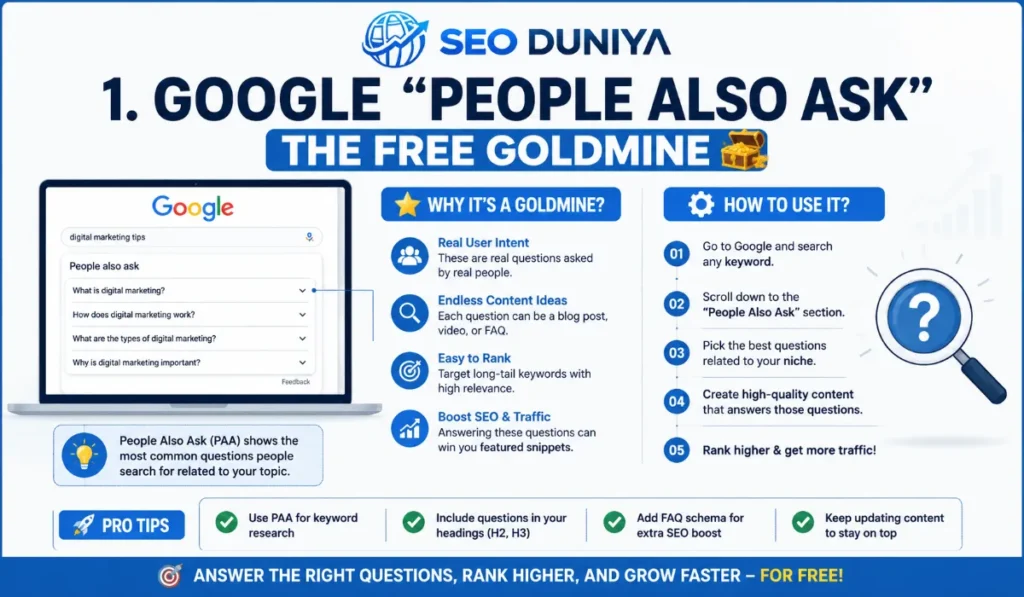
Every time someone searches on Google, PAA shows a list of related questions that real users are asking. These are not made-up questions. They come from actual search data.
How to Use It
- Open Google and search your main keyword
- Scroll down to find the “People Also Ask” box
- Click on each question — more questions will expand below
- Collect 15–20 questions per topic
- Group similar questions into content clusters
Why It Matters for AEO and GEO
Google AI Overviews often pull answers directly from pages that already rank in PAA. If your content answers a PAA question clearly and directly, AI tools are far more likely to cite your page.
Quick Tip: Always answer the question in your first 2–3 sentences. AI engines prioritize pages that give direct answers fast.
| PAA Advantage | AI Visibility Impact |
| Shows real search intent | Aligns with AI query patterns |
| Free to use anytime | No tool cost |
| Updates regularly | Fresh question data always |
2. Reddit and Quora — Where Raw Questions Live
Reddit and Quora are two platforms where people ask questions they feel too embarrassed to Google. That means you find honest, unfiltered, high-intent questions — perfect for FAQ content.
How to Mine Reddit
- Search your niche topic on reddit.com
- Filter posts by Top and Hot
- Look for threads with the most comments
- Read the comment section — follow-up questions there are often gold
- Note the exact words people use
How to Mine Quora
- Search your keyword on quora.com
- Filter by Most Answered
- Read multiple answers — the questions people ask in comments are even better than the main post
Why This Works for GEO
Generative engines like Perplexity often surface content that mirrors community discussions. When your content uses the same natural language that Reddit and Quora users write in, it matches the same queries AI tools receive every day.
3. Amazon and Product Reviews — A Hidden FAQ Database
This source surprises most content creators — but it works incredibly well, especially for product-based niches.
Amazon’s product pages contain thousands of real customer questions. These are questions buyers had before, during, or after their purchase. They show you exactly what people want to know.
How to Extract FAQ Topics
- Go to any relevant product page on Amazon
- Scroll to “Customer Questions & Answers”
- Read 1-star and 3-star reviews — these hold the most unanswered concerns
- Look for phrases like “I wish I knew,” “no one explains,” “confused about”
Each phrase signals a content gap you can fill.
AEO Opportunity Here
When someone asks ChatGPT “What should I know before buying X?”, the AI pulls from pages that answer pre-purchase questions clearly. Your FAQ content can earn that citation.
| Review Type | Signal to Look For | FAQ Angle to Write |
| 1-star reviews | Unmet expectations | “What does X actually include?” |
| 3-star reviews | Confusion or missing info | “How does X work step by step?” |
| Q&A section | Direct buyer questions | Use exact phrasing as FAQ title |
4. Your Own Customer Emails and Support Chats
This is the most overlooked source on this list — and the most valuable.
Your existing customers ask you questions every single day. These questions are 100% real, 100% relevant, and come directly from your target audience. There is no better FAQ research than this.
How to Turn Support Data Into FAQ Content
- Export your last 3 months of support emails or chat logs
- Highlight questions that appear 3 or more times
- Group them into topics: pricing, features, troubleshooting, how-to, comparisons
- Write one FAQ section or blog post per topic cluster
Why This Is Perfect for AEO
Answer engines work best with content that matches real user intent. Nothing is more intentional than a question your actual customer typed. These questions often have zero competition in search — meaning your content ranks faster.
Pro Tip: Add a simple tag system to your support inbox. After 30 days of tagging questions by topic, you will have a full FAQ content calendar ready to go.
5. Ask AI Tools Directly — The Fastest Shortcut
This is the smartest FAQ mining hack of 2025. You can ask AI tools directly what questions people have about your topic — and then create content to answer those questions.
Prompts That Work
Open ChatGPT, Claude, or Perplexity and try:
- “What are the 20 most common questions people ask about [your topic]?”
- “List FAQs someone would search before buying [your product].”
- “What does someone need to know about [topic] that most websites miss?”
You get a full list of high-intent questions in under a minute.
GEO Advantage of This Method
AI tools answer the same questions their users ask them. By asking AI what people ask, you reverse-engineer the content gaps AI tools have — and fill them with your pages.
| AI Tool | Best Use for FAQ Mining |
| ChatGPT | Broad topic FAQs and intent research |
| Perplexity | Research-backed questions with sources |
| Claude | Nuanced framing and content structuring |
| Google Gemini | PAA-aligned Google-focused question lists |
How to Structure FAQ Content for Maximum AI Visibility
Finding questions is only half the work. You need to structure your answers so AI can read and cite them easily.
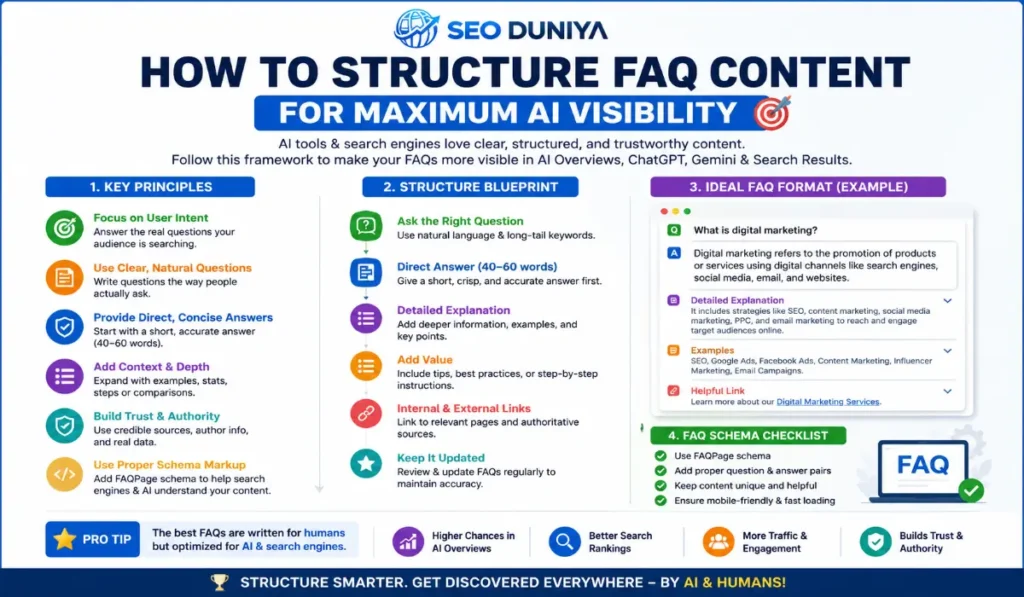
Use this simple format for every FAQ:
- Put the exact question as your heading (H3)
- Answer it in 2–3 clear sentences right away
- Add a supporting detail, example, or stat
- End with a related question or next step
This structure works for Google featured snippets and AI-generated answers. It tells every search engine — human or machine — that your content is trustworthy and complete.
Quick Summary Checklist
| Source | Time Needed | Best For |
| Google PAA | 15 minutes | High-volume, fast-win queries |
| Reddit & Quora | 30 minutes | Conversational, long-tail FAQs |
| Amazon Reviews | 20 minutes | Product and buyer-intent content |
| Customer Support Data | 1 hour | Niche, high-intent FAQs |
| AI Tools | 10 minutes | Quick ideation and gap research |
Final Thoughts
AI search does not replace content — it rewards better content. When you mine FAQ topics from the right sources and write clear, direct answers, your pages start appearing inside AI-generated results, featured snippets, and People Also Ask boxes.
Pick one source from this list today. Find 10 real questions your audience is asking. Write honest, clear answers.
That is how you build AI visibility — one helpful answer at a time.
Bookmark this guide and revisit it every quarter as AI search behavior keeps evolving.
Frequently Asked Questions
Q1. What is FAQ content in SEO?
FAQ content is a format where you write questions your audience asks and answer them clearly on your page. It helps search engines and AI tools understand what your page is about and when to show it in results.
Q2. How does FAQ content improve AI visibility?
AI tools like ChatGPT and Perplexity look for pages that directly answer questions. When your content is structured in a question-and-answer format, AI engines find it easier to read and cite your page in their responses.
Q3. What is AEO and how is it different from SEO?
SEO helps you rank on Google’s search results page. AEO (Answer Engine Optimization) helps your content appear inside AI-generated answers on tools like ChatGPT, Perplexity, and Google AI Overviews. FAQ content supports both at the same time.
Q4. What is GEO in content marketing?
GEO stands for Generative Engine Optimization. It means writing content in a way that AI-powered search tools like Google SGE can pull and show to users directly inside their generated responses.
Q5. How many FAQs should I add to a blog post?
Aim for 5 to 10 FAQs per blog post. Each FAQ should answer one specific question in 2–4 sentences. Keep answers clear and direct so both readers and AI tools can understand them fast.
Q6. Do FAQs help with Google featured snippets?
Yes. Google often pulls FAQ answers directly into featured snippets and People Also Ask boxes. When you use the exact question as a heading and answer it immediately below, you increase your chances of winning a featured snippet.
Q7. Which is the best free tool to find FAQ topics?
Google’s People Also Ask section is the best free tool for FAQ research. It shows real questions from real users. You can also use Reddit, Quora, and AI tools like ChatGPT to find additional question ideas at no cost.