

AI Visibility Measurement: Why It Matters More Than Traditional SEO in 2026
Search has changed dramatically over the past few years. Users no longer rely only on Google Search to find answers. Today, millions of people ask questions directly to AI platforms like ChatGPT, Google AI Mode, Gemini, Microsoft Copilot, Claude, and Perplexity AI.
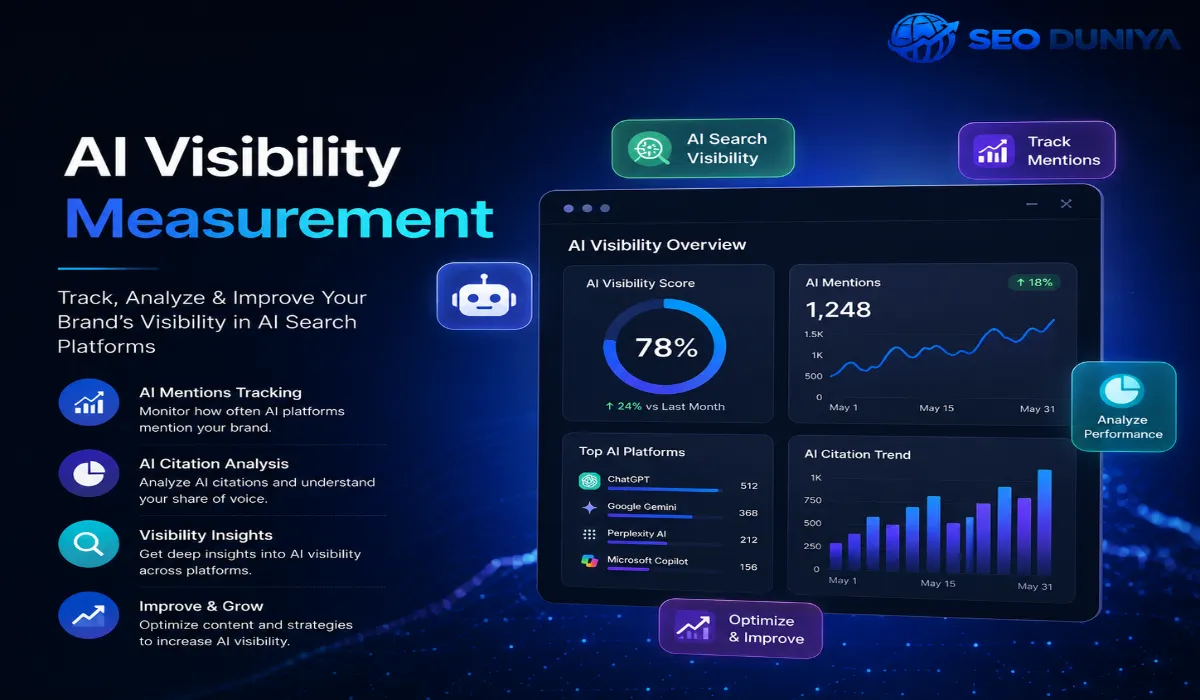
This shift has introduced a new digital marketing metric known as AI Visibility Measurement. Instead of focusing only on keyword rankings, businesses now need to measure how often AI assistants mention, recommend, or reference their websites, products, and services.
Traditional SEO is still important, but AI-powered search engines evaluate authority, trust, structured data, topical expertise, and user satisfaction differently. If your brand isn’t visible in AI-generated responses, you’re missing a growing source of traffic and brand awareness.
In this guide, you’ll learn what AI Visibility Measurement is, why it matters, which metrics to track, and how to improve your visibility across AI search platforms using modern SEO and GEO (Generative Engine Optimization) strategies.
What Is AI Visibility Measurement?
AI Visibility Measurement is the process of tracking and analyzing how frequently your website, brand, or content appears in responses generated by artificial intelligence platforms.
Instead of measuring only search rankings, AI visibility focuses on questions such as:
- Does ChatGPT mention your website?
- Is your brand recommended by Gemini?
- Does Perplexity cite your content?
- Does Google AI Overview reference your pages?
- Are your products suggested when users ask AI for recommendations?
The better your AI visibility, the greater your chances of attracting highly qualified users from AI-powered search experiences.
Why AI Visibility Measurement Is Becoming Essential
AI search is changing user behavior.
Instead of opening ten search results, users now receive one complete answer generated by AI. That means websites receiving AI citations gain significantly more trust and attention.
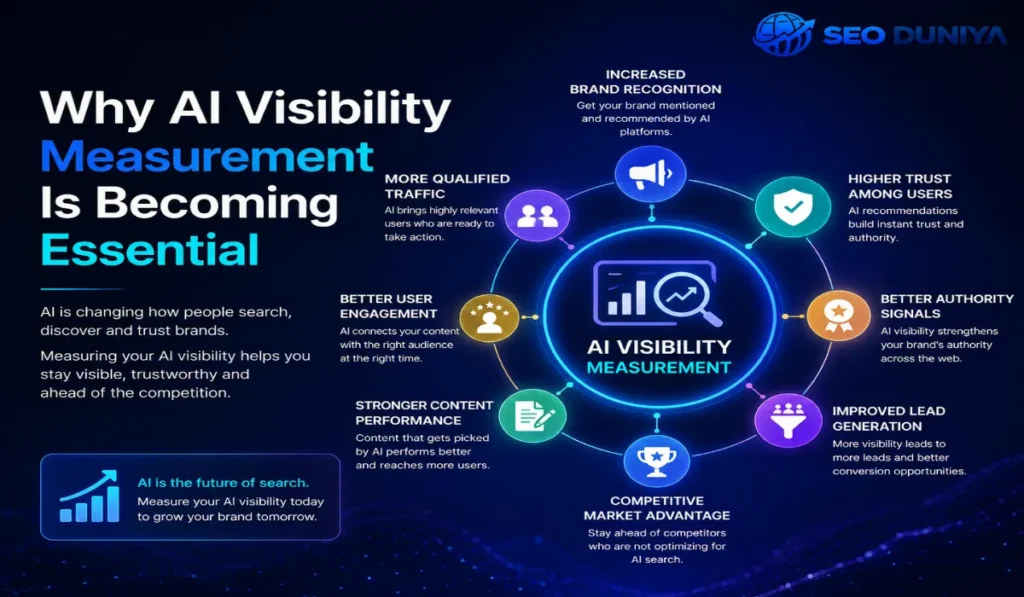
Some major reasons businesses should monitor AI visibility include:
- Increased brand recognition
- More qualified traffic
- Higher trust among users
- Better authority signals
- Improved lead generation
- Stronger content performance
- Competitive market advantage
Companies that start optimizing for AI today will likely dominate tomorrow’s search landscape.
Traditional SEO vs AI Visibility Measurement
Although both aim to increase online presence, they measure different aspects of search performance.
| Traditional SEO | AI Visibility Measurement |
| Keyword rankings | AI citations |
| Organic traffic | AI-generated mentions |
| SERP positions | AI recommendation frequency |
| Click-through rate | AI answer inclusion |
| Backlinks | Authority and trust signals |
| Indexed pages | Knowledge graph presence |
| Featured snippets | AI-generated summaries |
The future belongs to businesses that combine both SEO and AI optimization.
How AI Systems Decide Which Websites to Mention
AI models don’t randomly select websites.
They evaluate multiple trust and authority signals before recommending a source.
Some important ranking factors include:
High-Quality Content
AI prefers detailed, original, and factually accurate content that answers user questions completely.
Topical Authority
Publishing multiple articles around a specific subject increases your expertise.
For example, if your website covers AI marketing, publish content about:
- AI SEO
- GEO
- AI Search Optimization
- AI Crawlers
- AI Citations
- AI Content Strategy
- AI Visibility Measurement
Together, these build topical authority.
Structured Data
Schema markup helps AI understand your content.
Useful schema types include:
- Article Schema
- FAQ Schema
- Organization Schema
- Breadcrumb Schema
- Product Schema
- Review Schema
Structured data improves machine readability and increases the likelihood of AI references.
Brand Authority
AI platforms often recommend well-established brands with consistent online presence.
Authority grows through:
- High-quality backlinks
- Expert content
- Positive reviews
- Brand mentions
- Strong social signals
Content Freshness
AI systems favor recently updated content.
Refreshing older articles with new statistics, examples, and insights improves AI visibility.
Key Metrics for AI Visibility Measurement
Businesses should monitor several metrics instead of relying on rankings alone.
AI Brand Mentions
Track how often AI assistants mention your business.
AI Citations
Monitor whether AI platforms cite your website as a trusted source.
AI Referral Traffic
Use analytics tools to identify visitors arriving from AI platforms.
AI Conversion Rate
Measure how many AI visitors become customers.
AI Share of Voice
Compare your AI visibility against competitors.
Knowledge Graph Presence
Ensure your brand information appears consistently across trusted platforms.
Entity Recognition
Search engines increasingly rely on entities instead of keywords.
Build strong entity relationships through consistent branding.
Best Tools for AI Visibility Measurement
Several modern tools help monitor AI search performance.
1. Google Search Console
Track organic impressions, clicks, and AI-related search trends.
2. Google Analytics 4
Measure AI referral traffic and conversions.
3. Ahrefs
Analyze backlinks, authority, and keyword performance.
4. Semrush
Monitor visibility, competitor performance, and brand growth.
5. Screaming Frog
Audit technical SEO and structured data.
6. Bing Webmaster Tools
Useful for Microsoft Copilot optimization.
7. AI Monitoring Platforms
New AI analytics platforms track:
- ChatGPT mentions
- Gemini visibility
- Perplexity citations
- Claude references
- AI recommendation frequency
These tools are becoming increasingly valuable for GEO professionals.
How to Improve AI Visibility Measurement
Improving AI visibility requires more than keyword optimization.
Create Comprehensive Content
Publish detailed articles that completely answer user intent.
Long-form guides generally perform better in AI-generated responses.
Answer Real Questions
Structure content around questions users genuinely ask.
Examples:
- What is AI Visibility Measurement?
- How do AI search engines rank websites?
- Why is GEO important?
Question-based content is easier for AI to understand.
Build Topical Clusters
Instead of isolated blogs, create interconnected content around one topic.
Example cluster:
AI Search
↓
AI SEO
↓
GEO
↓
AI Crawlers
↓
AI Visibility Measurement
↓
AI Ranking Factors
↓
AI Analytics
Internal linking strengthens authority.
Improve EEAT Signals
Google and AI systems value:
- Experience
- Expertise
- Authoritativeness
- Trustworthiness
Display author information, update content regularly, cite credible sources, and maintain factual accuracy.
Optimize for Entities
Mention recognized entities naturally.
Examples include:
- ChatGPT
- Google AI Mode
- Gemini
- Microsoft Copilot
- Claude
- Perplexity AI
Entity optimization helps AI better understand context.
Add Schema Markup
Schema improves machine readability.
Recommended schema:
- FAQ
- Article
- Organization
- Person
- Breadcrumb
- Review
Build High-Quality Backlinks
Authority remains one of the strongest trust signals.
Focus on backlinks from:
- Industry blogs
- News websites
- Educational institutions
- Research publications
Keep Content Updated
AI platforms prioritize current information.
Review important pages every few months.
Common Mistakes That Reduce AI Visibility
Many websites unknowingly limit their AI visibility by making avoidable mistakes.
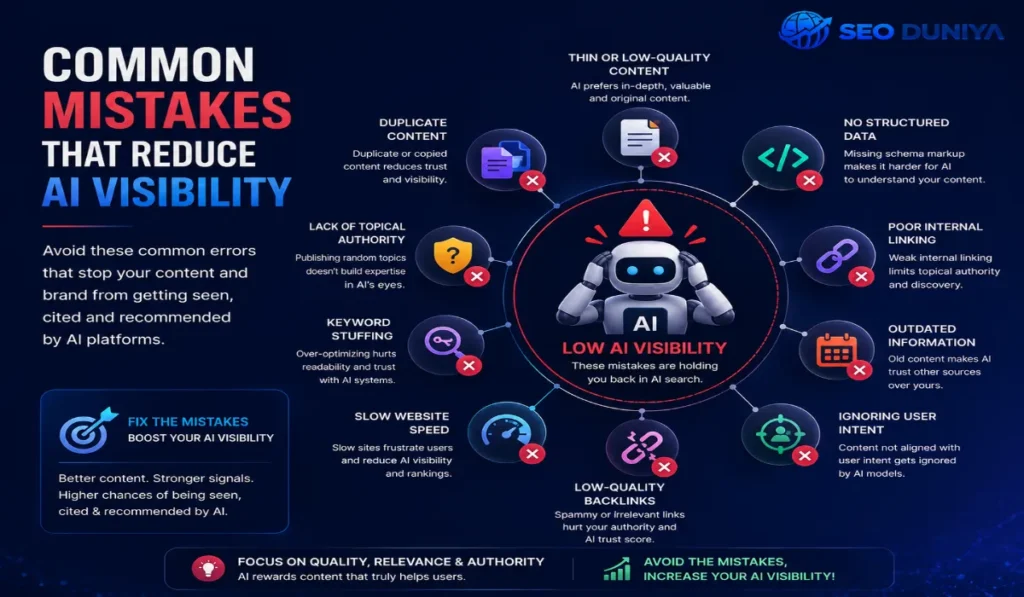
Common issues include:
- Thin content
- Duplicate articles
- Poor internal linking
- Missing schema markup
- Slow website speed
- Low-quality backlinks
- Outdated information
- Weak topical authority
- Keyword stuffing
- Ignoring user intent
Avoiding these problems significantly improves your chances of appearing in AI-generated responses.
The Future of AI Visibility Measurement
AI-powered search is expected to become the primary way users discover information online.
Instead of simply ranking webpages, AI engines will rank trusted entities, authoritative brands, and reliable knowledge sources.
Future AI visibility metrics may include:
- AI citation score
- AI authority index
- Brand recommendation frequency
- Multi-model visibility score
- Entity confidence rating
- AI engagement signals
Businesses investing in GEO today will be better positioned as AI search continues to evolve.
Final Thoughts
AI Visibility Measurement is rapidly becoming one of the most important performance metrics in digital marketing. While traditional SEO focuses on search rankings, AI visibility measures whether your brand is recognized, cited, and recommended by AI-powered search engines and assistants.
To improve your AI visibility, focus on publishing authoritative content, building topical authority, implementing structured data, earning quality backlinks, strengthening EEAT signals, and optimizing for entities rather than relying solely on keywords. By combining proven SEO practices with Generative Engine Optimization (GEO), businesses can increase their chances of being featured in AI-generated answers, attract high-intent users, and stay competitive in the future of search.
As AI search continues to evolve, measuring and improving your AI visibility will become just as important as tracking traditional keyword rankings. Organizations that adapt early will gain stronger brand recognition, greater trust, and sustainable organic growth in the AI-first era.