
Google Search Traffic to Open Web Drops to 23%: Here’s What the Data Shows
The internet runs on traffic. Websites depend on visitors, publishers depend on readers, and businesses depend on people finding them through search. For years, Google has been the biggest driver of that traffic. But something is changing — and the latest data makes it impossible to ignore.
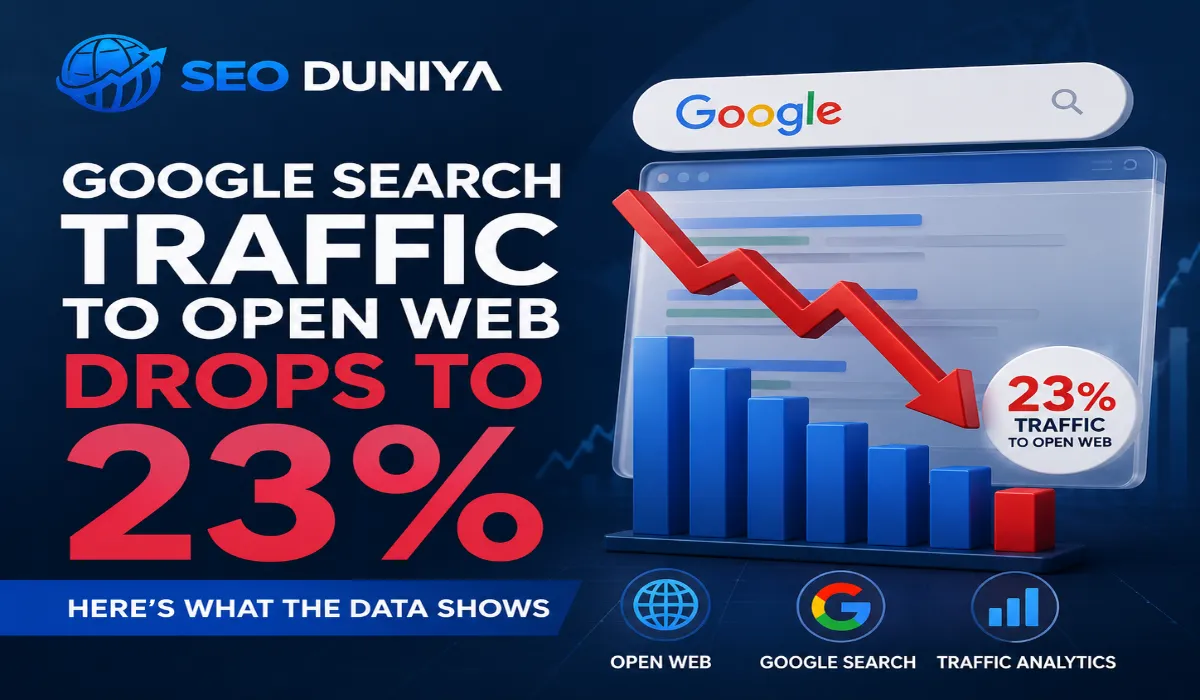
According to recent research, only 23% of Google searches now result in a click to the open web. That means out of every 100 people who search something on Google, only about 23 of them actually land on an external website. The rest either get their answer directly on Google’s search results page, or they click on something within Google’s own ecosystem.
This is not just a number. It is a fundamental shift in how Google operates — and it has serious consequences for every website, blog, news outlet, and online business that depends on search traffic to survive.
What Does “Open Web” Traffic Actually Mean?
When we say “open web,” we mean the millions of independent websites, blogs, news portals, e-commerce stores, and online platforms that exist outside of Google’s own products.
Every time someone clicks a search result and lands on one of these sites — that is open web traffic. It is the lifeblood of digital publishing. Ad revenue, product sales, email signups, brand awareness — all of it depends on people actually arriving at your website.
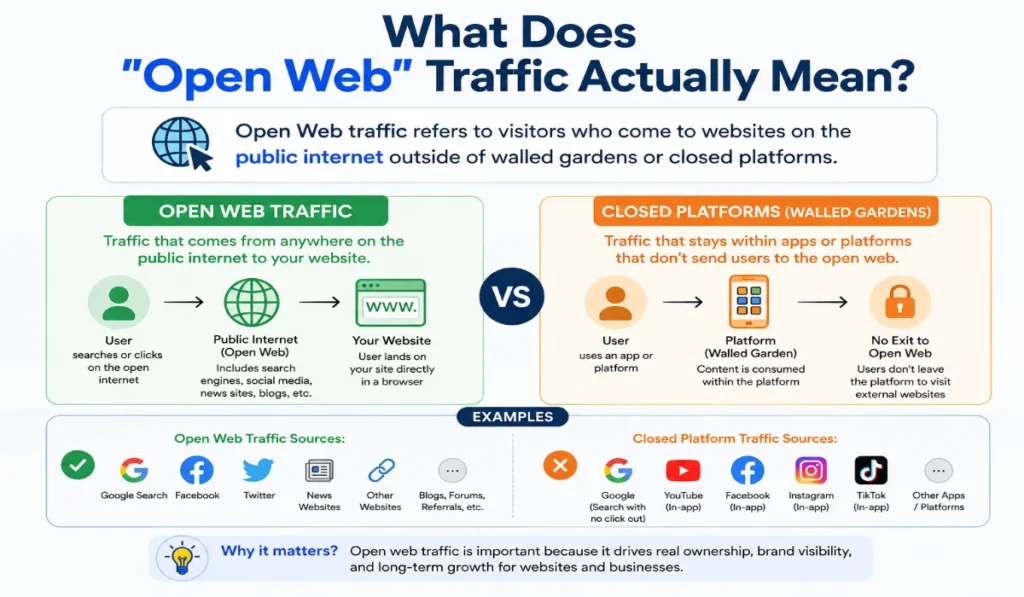
The drop to 23% means Google is now sending far less of this traffic than it used to. And this has been a steady, ongoing decline — not a sudden overnight change.
The Numbers: How Bad Is the Drop?
To truly understand the scale of this change, it helps to look at the data over time. A few years ago, more than half of all Google searches led to a click on an external website. Today, that number has fallen to nearly one in four.
| Year / Period | Estimated Open Web CTR | Zero-Click Share |
| 2019 (estimate) | ~50%+ | ~49% |
| 2021 | ~35–40% | ~57% |
| 2023 | ~28–32% | ~60%+ |
| 2025 (latest data) | ~23% | ~65%+ |
The trend is clear and consistent. Google search is increasingly becoming a destination in itself, rather than a gateway to the broader web.
Why Is Google Search Traffic Declining to the Open Web?
This drop did not happen by accident. There are several specific changes within Google’s search product that have directly caused this shift.
AI Overviews Are Answering Questions Directly
One of the biggest recent changes is the rollout of Google’s AI Overviews. These are AI-generated summaries that appear at the very top of search results, above all organic links.
When a user searches a question, Google’s AI reads multiple web pages, summarises the key information, and presents it directly on the results page. The user gets their answer without ever needing to click through to any website. This alone is responsible for a significant portion of the lost traffic to the open web.
Zero-Click Searches Have Become the Norm
Even before AI Overviews, Google was already moving in this direction through featured snippets, knowledge panels, and direct answer boxes. These features are designed to put the answer front and centre — right on the search results page itself.
For simple factual queries — like “what is the capital of France” or “how tall is Mount Everest” — users almost never need to click a website anymore. Google tells them instantly. This zero-click behaviour is now the dominant pattern for a large portion of searches.
Google Is Sending More Clicks to Its Own Products
When users do click something, they are increasingly clicking on Google-owned properties rather than external websites. Here is where those clicks are going:
- YouTube — for video content and tutorials
- Google Maps — for local business searches and directions
- Google Shopping — for product searches and price comparisons
- Google Flights and Hotels — for travel-related queries
- Google Images — for visual searches
These are all Google products. When a user clicks from Google Search to YouTube or Google Maps, that traffic never reaches the open web. It stays entirely within Google’s ecosystem.
People Also Ask Boxes Reduce the Need to Click
The “People Also Ask” (PAA) boxes that appear mid-results page are another major factor. These expandable question-answer sections allow users to explore multiple related queries without ever leaving the search results page. Each answer satisfies another potential reason to visit a website — and another lost click for publishers.
Who Is Getting Hurt the Most?
The impact of this traffic decline is not felt equally across all types of websites. Some categories are being hit much harder than others.
| Content Type | Impact Level | Why? |
| News and media publishers | Very High | AI Overviews summarise news stories directly |
| How-to and tutorial blogs | High | Featured snippets answer these completely |
| Definition and explainer sites | High | Knowledge panels replace these entirely |
| E-commerce stores | Medium | Google Shopping absorbs product search clicks |
| Local businesses | Medium | Google Maps and local packs take local searches |
| SaaS and software sites | Lower | Users still need to visit to sign up or use the product |
Publishers and informational websites are taking the heaviest losses. If your business model depends on traffic from question-based or how-to content, the impact of this shift is already very real.
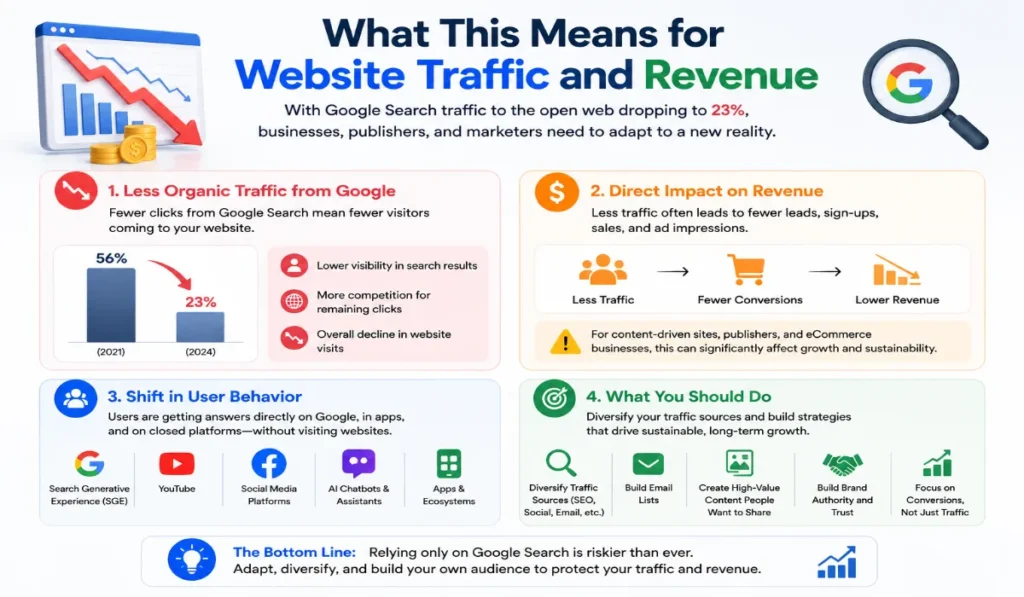
What This Means for Website Traffic and Revenue
The practical consequences of this shift are significant. Websites that built their audience on organic Google traffic are now finding that:
- Page view numbers are declining even when their rankings have not changed
- Click-through rates from Google have dropped significantly compared to previous years
- Ad revenue is falling because fewer visitors are arriving on site
- Top-ranking content is now being used to fuel AI Overviews without sending any traffic back
- Email list growth and lead generation have slowed because fewer people land on pages with sign-up forms
The painful irony is that a website can rank in position one on Google and still receive very little traffic — because the AI Overview sitting above it answers the question before anyone scrolls down to the organic results.
Is Google Doing This Intentionally?
This is a question many publishers and digital professionals are asking. The honest answer is: it is complicated.
Google’s stated mission is to organise the world’s information and make it universally accessible. Giving users faster, more direct answers genuinely serves that mission. From a user experience standpoint, AI Overviews and zero-click results are actual improvements — people get answers faster.
But Google also benefits commercially from keeping users inside its own ecosystem longer. More time on Google means more ad impressions, more YouTube watch time, more Google Shopping transactions. The incentives are clearly aligned for Google to reduce outbound traffic — regardless of whether that is the stated intention.
What is clear is that the effect on external publishers has been severe, and so far, Google has made no significant moves to reverse this trend.
How Are Publishers and Website Owners Responding?
Diversifying Traffic Sources
Many publishers are reducing their dependence on Google by building up other traffic channels — social media, email newsletters, direct app downloads, and online communities. The goal is to build an audience that does not require Google to reach them.
Focusing on Content Google Cannot Easily Summarise
In-depth investigative reporting, original research, proprietary data, exclusive interviews, and strong opinion content are much harder for AI systems to simply summarise. Publishers creating this type of content tend to retain more click-through traffic because users genuinely need to visit the page to get the full value.
Building a Recognisable Brand
Brands that users know and actively search for by name are better protected. If someone searches “TechCrunch AI news” rather than just “AI news,” they are likely to click through regardless of what AI Overviews say. Building a loyal, returning audience reduces exposure to zero-click risk significantly.
Exploring Legal and Regulatory Routes
In several countries, news publishers have pursued legal action or lobbied for legislation requiring Google to pay for the use of their content in AI-generated summaries. Australia has already passed legislation in this area, and similar conversations are ongoing in the EU and the UK.
What Does the Future Look Like?
If the current trend continues — and there is no strong reason to believe it will reverse — the open web’s share of Google search traffic could fall even further. AI capabilities are improving rapidly, and Google has shown no signs of slowing down the rollout of AI-powered search features.
Some analysts believe we are moving toward a future where the majority of Google searches produce zero outbound clicks. In that world, the open web does not disappear — but it becomes far less dependent on Google as a discovery mechanism than it has been for the past two decades.
The websites and publishers that will survive this shift are those that offer something AI summaries simply cannot replace: original reporting, real human perspective, exclusive tools, community, and content that requires the full page to be valuable.
Final Thoughts
The drop to 23% is more than a traffic statistic. It is a signal that the relationship between Google and the open web is changing in a fundamental way. For two decades, Google and websites existed in a mutually beneficial cycle — websites created content, Google ranked it, and Google sent traffic back to those websites in return.
That cycle is breaking down. Google is increasingly consuming web content to power its own AI features rather than directing users to the source. The traffic that used to flow outward to publishers is now staying inside Google.
Understanding this shift is the first step. How the publishing industry, regulators, and content creators respond to it will shape the future of the open web.
Frequently Asked Questions
Q1: Why is Google search traffic decreasing to websites?
Google is keeping users on its own platform through AI Overviews, featured snippets, and zero-click answers — so fewer people click through to external websites.
Q2: What is a zero-click search?
A zero-click search is when a user searches something on Google and gets their answer directly on the results page — without clicking any website link.
Q3: How do AI Overviews affect website traffic?
Google’s AI Overviews summarise content from multiple websites and display the answer at the top of search results, reducing the need for users to visit the original source.
Q4: Which websites are losing the most traffic from Google?
News publishers, how-to blogs, and informational websites are losing the most traffic as Google’s AI features directly answer the queries these sites used to rank for.
Q5: How can websites survive the Google traffic drop?
Websites can survive by diversifying traffic sources, building email lists, creating original research content, and building a strong brand that users search for directly.