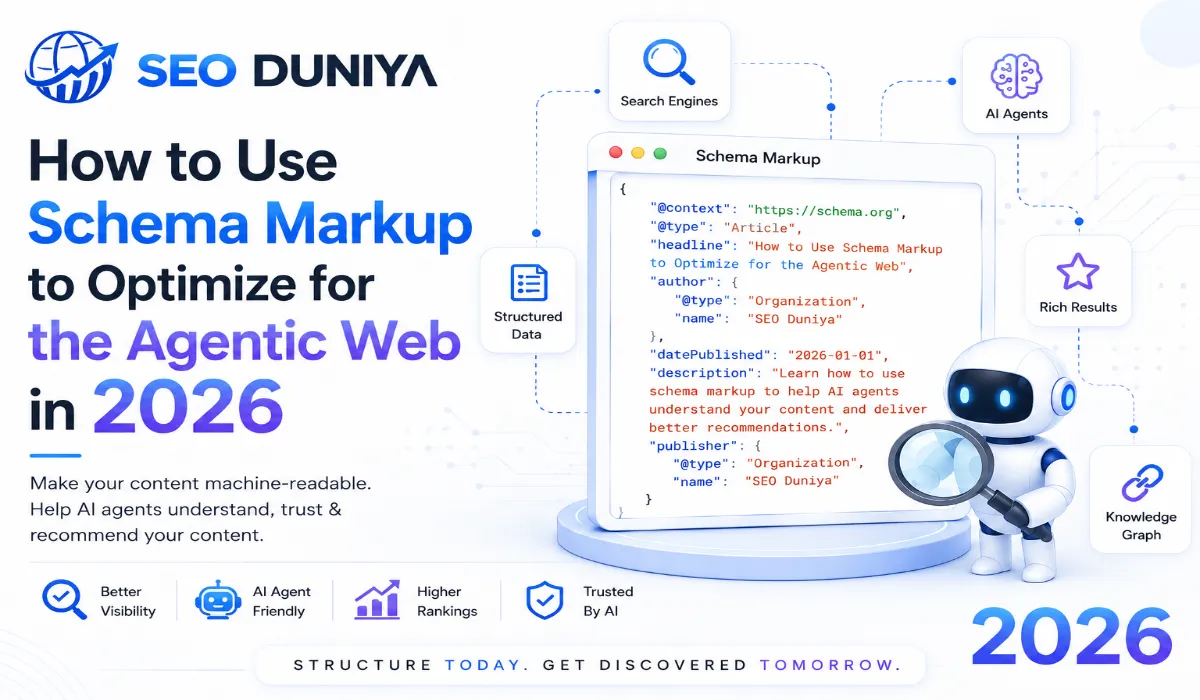

How to Use Schema Markup to Optimize for the Agentic Web in 2026
The internet is not what it used to be. In 2026, over 60% of all Google searches end without a single click. Users are getting their answers directly from AI-powered results — without ever visiting a website.
This is the agentic web — a new era where AI agents like ChatGPT, Google AI Overviews, Perplexity, and Microsoft Copilot browse the web, read content, and answer questions on behalf of users. These agents do not read websites the way humans do. They look for structured, machine-readable information.
That is exactly where schema markup comes in.
If you want your website to survive and grow in 2026, you need to understand schema markup, implement it correctly, and optimize it for the agentic web. This guide will walk you through everything — step by step, in simple English.
What Is Schema Markup?
Schema markup is a type of code — written in a format called JSON-LD — that you add to your website’s HTML. It does not change how your website looks to humans. Instead, it tells search engines and AI systems what your content means.
Think of it this way: your blog post says “Dr. Sarah Lee has 10 years of experience.” A human reads that and understands she is a doctor. But an AI agent needs more clarity. Schema markup tells the AI: “This is a Person, her name is Sarah Lee, her jobTitle is Doctor, and her yearsOfExperience is 10.”
That is the power of schema markup. It removes guesswork for machines.
Schema markup is maintained at Schema.org — a shared vocabulary created by Google, Bing, Yahoo, and Yandex. When you use schema markup correctly, you speak the same language as every major search engine and AI platform.
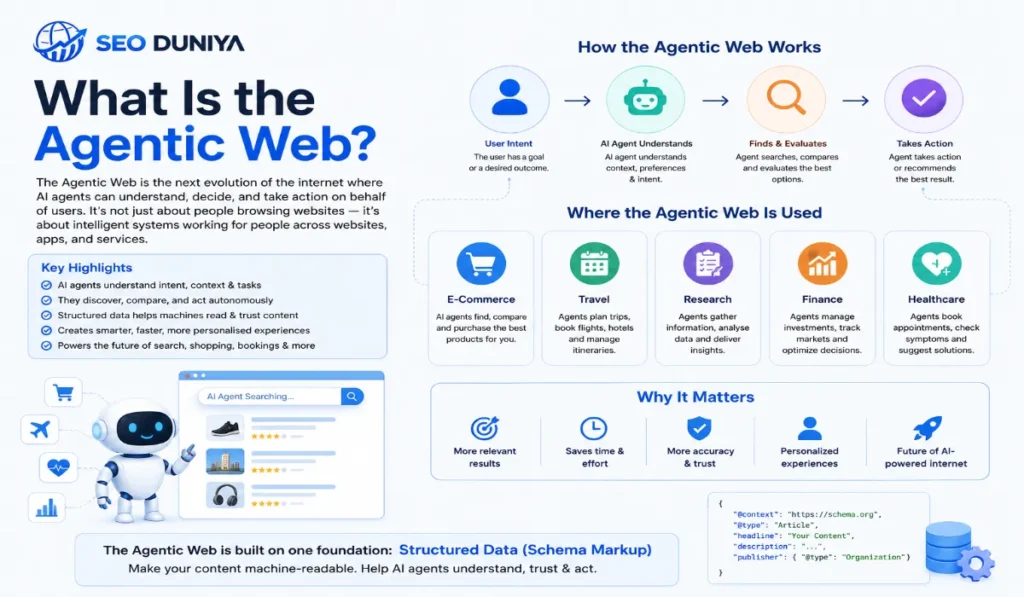
What Is the Agentic Web?
The agentic web is a new model of how the internet works. Instead of a human typing a query and clicking links, AI agents do the searching, reading, and answering automatically.
These AI agents — powered by systems like ChatGPT, Perplexity, and Google’s AI Mode — crawl websites, extract information, and build answers without human involvement. They are designed to complete tasks on your behalf.
Two important new technologies are shaping the agentic web:
NLWeb (Natural Language Web): An open-source protocol created by Microsoft. NLWeb turns websites into conversational, AI-queryable knowledge sources. It works by crawling your schema markup and storing it as vectors that AI can search semantically.
MCP (Model Context Protocol): A standard that allows AI systems to directly access and retrieve structured data from websites. Every NLWeb instance operates as an MCP server — meaning your schema markup becomes the direct data feed for AI agents.
In simple terms: Schema markup is your website’s knowledge API for the agentic web.
Why Schema Markup Matters More Than Ever in 2026
Schema markup has always helped with SEO. But in 2026, it has become far more important for three big reasons:
1. AI Overviews and AI Mode use structured data.
Google officially confirmed in April 2025 that structured data gives websites an advantage in AI-generated search results. Microsoft Bing also confirmed that schema markup helps their AI systems understand content for Copilot responses.
2. 65% of AI-cited pages use structured data.
Research shows that pages which appear in AI answers are significantly more likely to have schema markup implemented. Without it, your content is nearly invisible to AI agents.
3. CTR improves by 20–30% with rich results.
When schema markup triggers rich results — like star ratings, FAQ dropdowns, prices, and review counts — your listing stands out. Users click more. Traffic grows.
This is why schema markup is no longer a “nice to have.” It is a core part of modern SEO, GEO (Generative Engine Optimization), and AEO (Answer Engine Optimization).
GEO and AEO: What They Mean and Why Schema Markup Drives Both
You may have heard these new terms. Here is what they mean:
GEO – Generative Engine Optimization means optimizing your content to appear in AI-generated answers on platforms like ChatGPT, Perplexity, and Google AI Overviews. Schema markup helps AI engines understand your content well enough to cite it in generated responses.
AEO – Answer Engine Optimization means optimizing your content to directly answer questions — so AI assistants and voice search tools surface your content as the answer. FAQ schema, HowTo schema, and Speakable schema are the most important schema types for AEO.
When you implement schema markup correctly, you are doing SEO, GEO, and AEO at the same time.
Top 5 Schema Types You Need for the Agentic Web
Not all schema types are equally powerful. Here are the five that matter most in 2026:
1. Article Schema
This is essential for every blog post and news article. It tells AI systems who wrote the content, when it was published, and what topic it covers. It also signals authorship and expertise — two major trust factors for AI-generated answers.
2. FAQ Schema
FAQ schema is one of the best tools for AEO. When you mark up a question-and-answer section on your page, AI agents can directly pull those answers. This is how your content gets featured in voice search results and AI Overviews.
3. Organization + knowsAbout Schema
This is a newer but highly impactful schema type. By declaring what topics your organization has expertise in using the knowsAbout property, you tell AI systems: “This website is a trusted authority on these subjects.” Google’s AI Mode uses this signal when selecting sources to cite.
4. HowTo Schema
HowTo schema is perfect for step-by-step guides and tutorials. It is heavily used in voice search, where users ask questions like “How do I add schema markup?” AI assistants read HowTo schema to give direct spoken answers.
5. BreadcrumbList + SiteNavigationElement Schema
These schema types help AI agents understand your website’s structure. A well-organized site with clear navigation schema is easier for AI to crawl, index, and recommend.
How to Implement Schema Markup: Step-by-Step
Here is a simple, beginner-friendly process to add schema markup to your website:
Step 1: Choose JSON-LD format.
JSON-LD is Google’s recommended format. It goes inside a <script> tag in your page’s <head> section. It does not affect page design.
Step 2: Select the right schema type.
Use Schema.org to find the correct type for your content. A blog post uses Article. A service page uses Service. A local business uses LocalBusiness.
Step 3: Fill in all required and recommended properties.
Do not skip fields. AI agents need complete information. For an Article, include author, datePublished, headline, description, and image at minimum.
Step 4: Test your schema.
Use Google’s free Rich Results Test tool at search.google.com/test/rich-results. Fix any errors before publishing.
Step 5: Use Schema Aggregation (if using WordPress).
Yoast SEO launched Schema Aggregation in March 2026 — a feature that connects all your structured data together into one clean, consistent knowledge graph. Enable it for maximum AI readiness.
Allow AI Bots to Crawl Your Site
One critical but often-missed step: check your robots.txt file. Many websites accidentally block AI crawlers like GPTBot (OpenAI), OAI-SearchBot, and PerplexityBot.
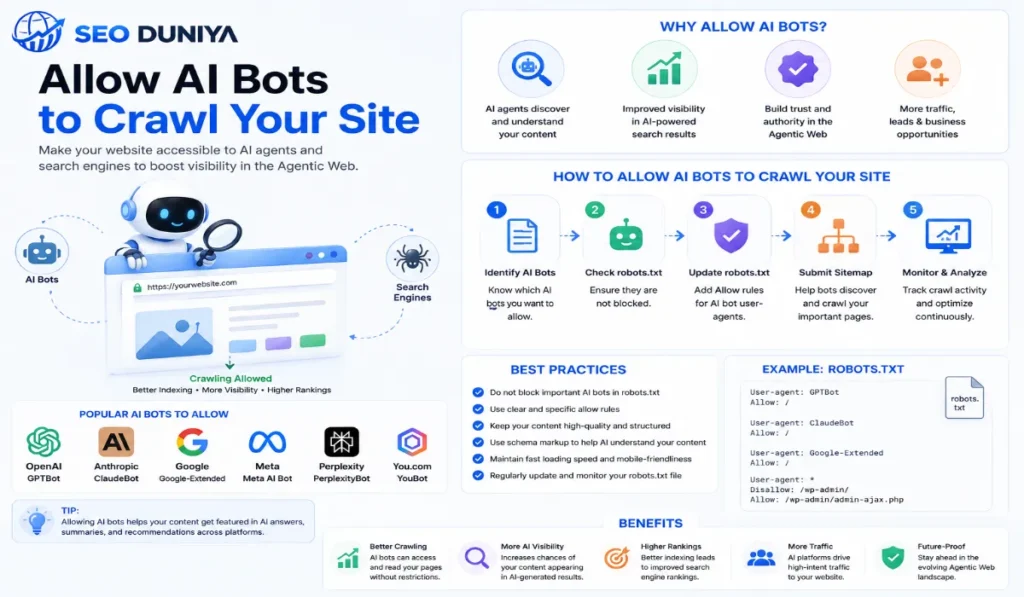
If these bots cannot crawl your site, your schema markup becomes useless for those platforms. Make sure your robots.txt allows all major AI crawlers.
Common Schema Markup Mistakes That Hurt Your SEO
Avoid these errors that many websites make:
- Missing required fields: Incomplete schema is ignored or penalized by Google.
- Duplicate schema on the same page: Causes confusion for search engines.
- Blocking AI crawlers in robots.txt: Your structured data never gets seen.
- Using outdated schema types: FAQ and HowTo rich results changed in 2023. Keep your schema current.
- Poorly maintained entity data: If your schema has wrong or conflicting information, AI agents will store inaccurate data about your brand.
Measuring the Success of Your Schema Markup
Once your schema is live, track these metrics:
- Google Search Console → Enhancements tab: Shows which rich results are active on your site.
- Rich Results Test: Run it monthly to catch any new errors.
- Organic CTR in Google Search Console: Compare CTR before and after schema implementation.
- AI search visibility: Use tools like Semrush or BrightEdge to monitor how often your content appears in AI-generated answers.
Conclusion: Schema Markup Is the Language of the Agentic Web
The agentic web is here. AI agents are already making decisions about what content to show, cite, and recommend — and they are doing it based on structured data.
Schema markup is not just an SEO tactic anymore. It is the foundation of how AI systems understand, trust, and surface your content in 2026 and beyond.
Start with Article schema and FAQ schema. Add Organization and knowsAbout properties. Allow AI bots to crawl your site. Test everything. And keep your structured data clean and up to date.
The websites that master schema markup today will be the ones that dominate AI search results tomorrow.
What schema type are you going to implement first? Drop your answer in the comments below.
Frequently Asked Questions
Q1: Does schema markup directly improve my Google rankings?
Schema markup does not directly boost rankings, but it improves click-through rates through rich results and increases the chances of appearing in AI Overviews — which drives more traffic overall.
Q2: What is the best schema type for blog posts?
Article schema is essential. Pair it with FAQ schema in your content for maximum AEO and GEO impact.
Q3: Is schema markup required for AI Overviews?
It is not strictly required, but pages with proper structured data are significantly more likely to be cited in AI-generated answers.
Q4: What is NLWeb and how does it use schema?
NLWeb is Microsoft’s open protocol that turns websites into AI-queryable interfaces. It crawls your schema markup and stores it as vector data that AI agents can search. Better schema = better AI visibility.
Q5: Can small websites benefit from schema markup?
Absolutely. Schema markup is free to implement and helps small websites compete with large ones by giving AI systems clear, trustworthy information about their content.