
In today’s digital world, every business wants to be visible online. Whether you run a small shop, a startup, or a personal blog, getting found on search engines is more important than ever. This is where SEO comes in.
Many people ask, What Is SEO and why does everyone talk about it? Simply put, SEO helps websites appear higher on search engine results pages. When your website ranks well, more people can find your content, products, and services.
In 2026, SEO is no longer just about adding keywords to a page. Search engines have become smarter and now focus on user experience, content quality, and helpful information. Artificial intelligence has also changed how search works, making it essential to create content that answers users’ questions naturally.
This guide explains SEO in simple words and helps beginners understand how it works in the modern digital landscape.
What Is SEO?
What Is SEO? SEO stands for Search Engine Optimization. It is the process of improving a website so that it appears higher in search engine results like Google and Bing.
The main goal of SEO is to increase organic traffic, which means getting visitors without paying for advertisements.
For example, if someone searches for “best digital marketing courses,” search engines display the most relevant and helpful pages first. SEO helps your website become one of those pages.
Simple Definition of SEO
SEO is the practice of:
- Improving website content
- Using relevant keywords naturally
- Making websites easy to navigate
- Increasing website speed
- Building trust and authority
- Creating a good user experience
Why SEO Matters in 2026
The online world is becoming more competitive every year. Millions of websites are created, and users expect quick and accurate answers.
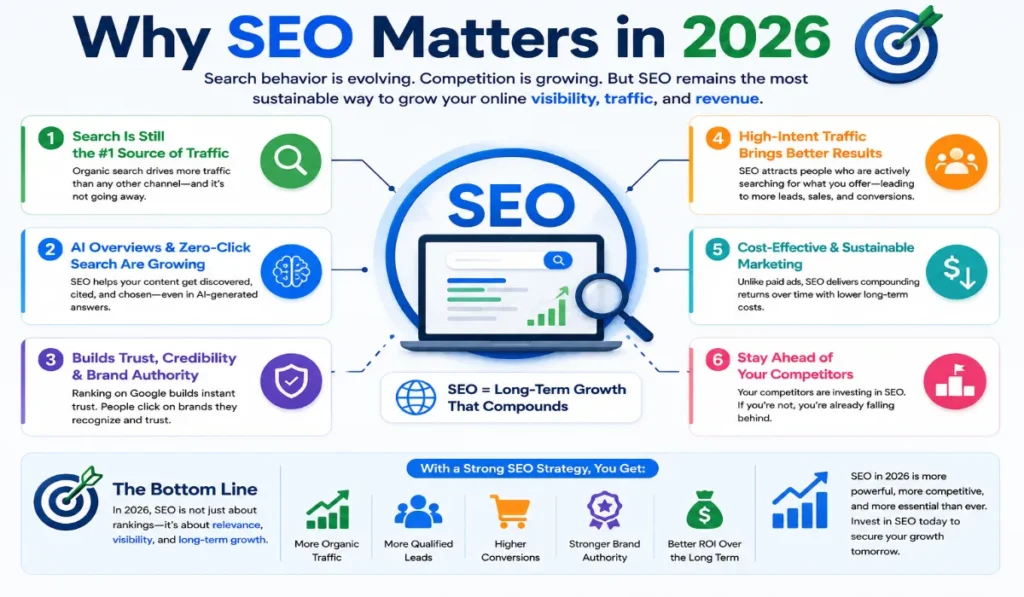
Here are some reasons SEO is important in 2026:
- Increases website visibility
- Brings targeted organic traffic
- Builds trust and credibility
- Generates leads and sales
- Improves user experience
- Supports long-term business growth
- Reduces dependence on paid advertising
Businesses that invest in SEO often see better online performance compared to those that ignore it.
How Search Engines Work
To understand What Is SEO, it is important to know how search engines operate.
Search engines mainly follow three steps:
| Step | Description |
| Crawling | Search engine bots discover web pages. |
| Indexing | Information is stored in search engine databases. |
| Ranking | Pages are ranked according to relevance and quality. |
Search engines use hundreds of factors to decide which pages deserve higher rankings.
These factors include:
- Content quality
- Page speed
- Mobile friendliness
- Website security
- User engagement
- Backlinks
- Search intent satisfaction
Types of SEO
SEO is divided into different categories. Each type plays an important role in improving website performance.
1. On-Page SEO
On-page SEO focuses on optimizing elements inside your website.
Examples include:
- Writing quality content
- Optimizing headings
- Adding keywords naturally
- Creating internal links
- Using descriptive URLs
- Writing meta descriptions
2. Off-Page SEO
Off-page SEO involves activities outside your website.
Examples include:
- Building backlinks
- Brand mentions
- Guest posting
- Social media sharing
- Online reputation management
3. Technical SEO
Technical SEO improves website performance and structure.
Important elements include:
- Website speed
- Mobile optimization
- XML sitemap
- HTTPS security
- Structured data
- Crawlability
4. Local SEO
Local SEO helps businesses appear in location-based searches.
Examples include:
- Creating business profiles
- Managing customer reviews
- Using local keywords
- Optimizing location pages
What Is SEO and How Does It Help Businesses?
Many companies wonder whether SEO is worth the investment. The answer is yes.
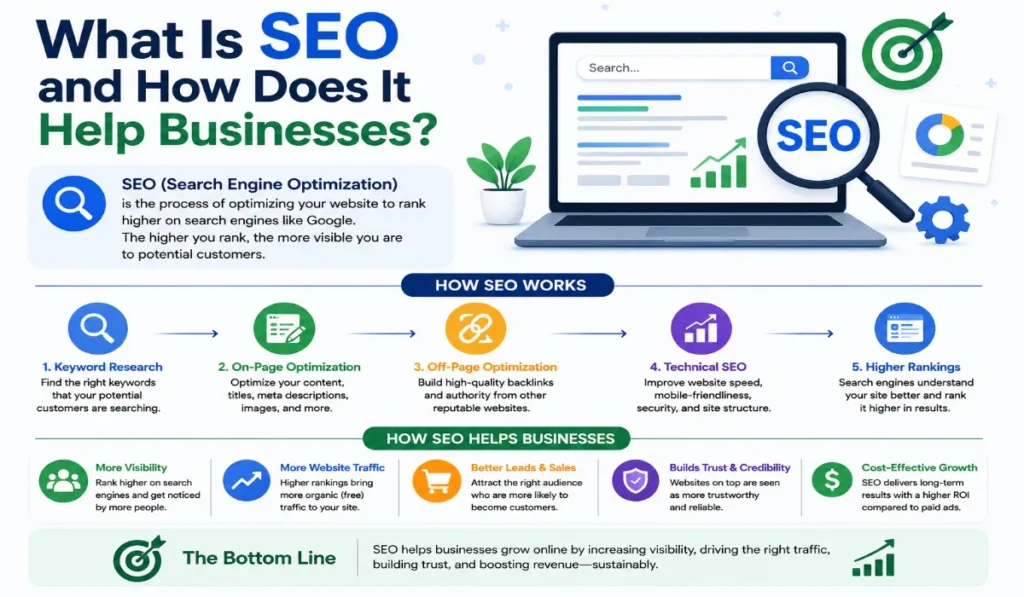
SEO helps businesses by:
Increasing Brand Awareness
Higher rankings make your business more visible to potential customers.
Bringing Quality Traffic
SEO attracts people actively searching for products or information.
Improving Credibility
Users usually trust websites that rank on the first page of search results.
Delivering Long-Term Results
Unlike paid advertisements, SEO can continue bringing traffic for months or even years.
Important Ranking Factors in 2026
Search engines continue updating their algorithms. In 2026, several ranking factors have become especially important.
High-Quality Content
Content should:
- Be original
- Provide useful information
- Solve user problems
- Answer search queries clearly
Search Intent
Search engines prioritize content that matches what users actually want.
For example:
| Search Query | Search Intent |
| Buy laptop online | Transactional |
| How to bake a cake | Informational |
| Nike official website | Navigational |
User Experience
Good user experience includes:
- Fast loading pages
- Easy navigation
- Mobile responsiveness
- Readable design
E-E-A-T
Search engines now value:
- Experience
- Expertise
- Authoritativeness
- Trustworthiness
Websites that demonstrate these qualities often perform better.
The Role of Keywords in SEO
Keywords are still important, but modern SEO focuses on natural usage rather than repetition.
When creating content:
- Understand user intent
- Use related terms naturally
- Answer common questions
- Write for humans first
Many beginners ask, What Is SEO and assume it only involves keywords. However, modern SEO is much broader and focuses on creating genuinely helpful content.
SEO Trends in 2026
SEO is constantly evolving. Several trends are shaping the future of search.
AI-Powered Search
Artificial intelligence helps search engines understand context and user intent more accurately.
Voice Search Optimization
More users are searching through voice assistants.
Content should:
- Use simple language
- Answer questions directly
- Include conversational phrases
Zero-Click Searches
Search engines increasingly provide answers directly on result pages.
To optimize for this:
- Use clear headings
- Create concise answers
- Structure information properly
Visual Search
Images and videos continue growing in importance.
Best practices include:
- Optimized image names
- Alt text descriptions
- Fast-loading media files
Common SEO Mistakes to Avoid
Beginners often make mistakes that hurt website performance.
Keyword Stuffing
Adding keywords repeatedly makes content difficult to read.
Ignoring Mobile Users
Most internet traffic now comes from mobile devices.
Publishing Low-Quality Content
Thin or copied content rarely ranks well.
Poor Website Speed
Slow websites increase bounce rates and reduce rankings.
Missing Internal Links
Internal links help users and search engines understand your website structure.
Basic SEO Checklist for Beginners
If you are starting your SEO journey, follow this simple checklist.
Content Optimization
- Create original articles
- Use headings properly
- Write naturally
- Answer user questions
Technical Improvements
- Improve loading speed
- Make the website mobile-friendly
- Use HTTPS
- Create an XML sitemap
User Experience
- Simple navigation
- Easy-to-read design
- Clear calls to action
- Helpful content structure
Authority Building
- Earn quality backlinks
- Publish expert content
- Build trust with users
The Future of SEO
The future of SEO is becoming more user-focused than ever.
Search engines now understand:
- Context
- User behavior
- Content quality
- Experience signals
- Intent behind searches
This means businesses should prioritize helping users instead of trying to manipulate rankings.
As technology evolves, understanding What Is SEO becomes even more important for anyone who wants online visibility and sustainable digital growth.
Final Thoughts
What Is SEO? SEO is the process of optimizing a website to improve its visibility in search engine results and attract organic traffic.
In 2026, successful SEO goes beyond keywords and focuses on creating useful, trustworthy, and user-friendly experiences. Search engines reward websites that genuinely answer questions and provide value to visitors.
Whether you are a blogger, student, freelancer, or business owner, learning SEO can help you build a stronger online presence and reach the right audience. By focusing on quality content, technical improvements, and user experience, you can create a website that performs well in modern search engines and continues growing over time.
Frequently Asked Questions
What is SEO
SEO (Search Engine Optimization) is the process of improving a website so it can rank higher on search engines like Google and attract more organic traffic without paying for ads.
Why is SEO important for websites?
SEO helps websites gain visibility, attract targeted visitors, build credibility, and generate leads or sales. It is one of the most effective long-term digital marketing strategies.
How does SEO work?
SEO works by optimizing content, improving website performance, building authority, and helping search engines understand your pages. Search engines then rank your website based on relevance and quality.
What are the main types of SEO?
The four main types of SEO are On-Page SEO, Off-Page SEO, Technical SEO, and Local SEO. Each type focuses on improving different aspects of a website’s search performance.
How long does SEO take to show results?
SEO is a long-term strategy. Most websites start seeing noticeable improvements within 3 to 6 months, depending on competition, content quality, and optimization efforts.
Is SEO still relevant in 2026?
Yes, SEO remains highly relevant in 2026. Although AI-powered search has changed how people find information, search engines still rely on high-quality, trustworthy, and user-focused content to deliver results.